
Marketing Pulse | Google Search
· Rollout completed August 21; reviewed September 16
Originally published August 20, 2026. Status corrected September 16 from Google's official record.
Google's August 2026 spam update is complete. Check the evidence before changing your site.
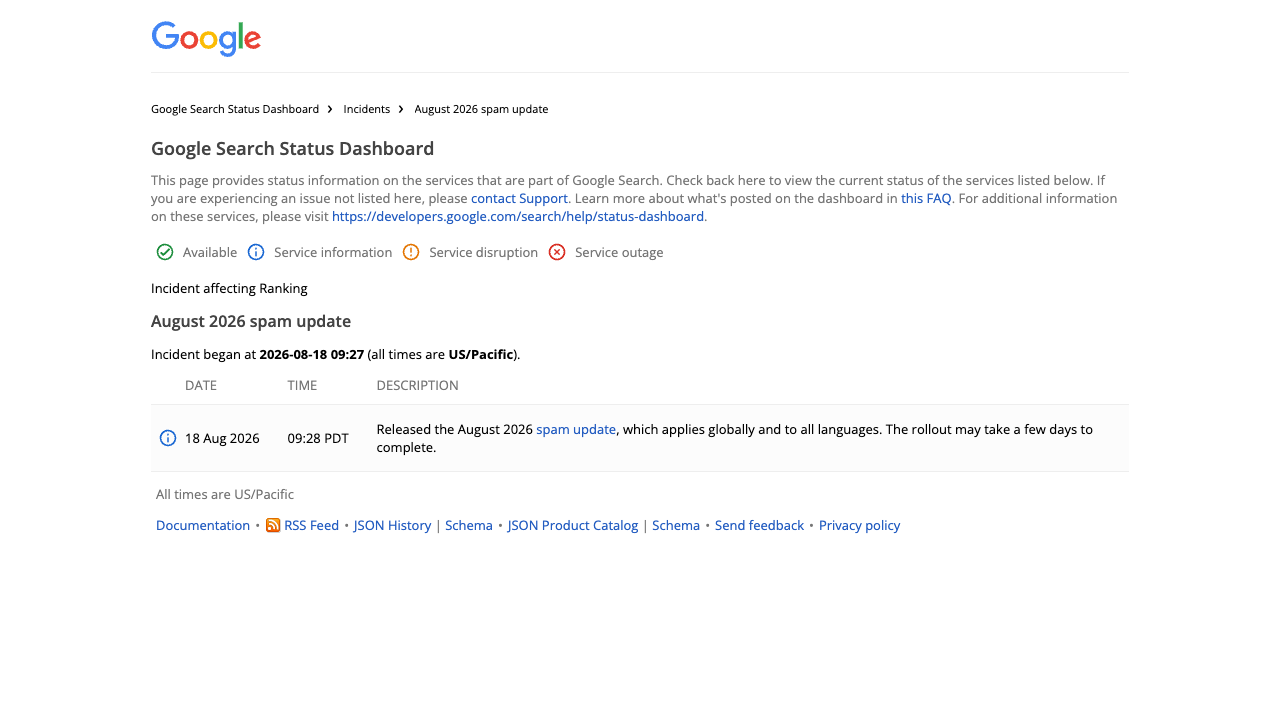
Google began a global, all-language spam update on August 18. Google recorded completion at 1:49 a.m. Pacific on August 21. The announcement does not establish the effect on any individual site.
Verdict
Mark the date. Protect the baseline. Leave the site alone until the evidence separates.
A ranking update can overlap with a deploy, a crawl failure, a canonical mistake, a reporting lag, a change in demand, or a normal day of volatility. The announcement is a reference point, not a diagnosis.
Annotate August 18 in Search Console and analytics. Save the pre-rollout page and query baseline.
Rewrite titles, delete pages, change internal links, or buy links because one chart moved.
A material decline persists after completion and is concentrated in identifiable pages, queries, or site sections.
What Google confirmed
The official record is short, and that boundary matters.
Google's Search Status Dashboard names the event the August 2026 spam update. It began at 9:27 a.m. Pacific on August 18. Google says it applies globally and covers all languages. The status dashboard records completion at 1:49 a.m. Pacific on August 21.
The record does not name a new spam policy. It does not say the update targets AI-written pages, local sites, affiliate pages, backlinks, ecommerce, or any single content format. Those claims require separate evidence.
Google's standing documentation says spam updates improve automated systems that detect search spam. A site that changes to comply may take months to be recognized by those systems. Some link-spam effects may not recover because the prior link benefit is removed rather than restored.
Use this now
The 20-minute rollout diagnosis.
- Save the date boundary.Annotate August 18 in Search Console, analytics, rank tracking, deploy records, and client reporting.
- Check whether the loss is real.Compare clicks, impressions, position, indexed pages, conversions, and revenue separately. A drop in one is not proof of a drop in the others.
- Rule out your own changes.Check releases, redirects, canonicals, robots directives, noindex tags, templates, internal links, structured data, and server availability.
- Find the concentration.Split brand and non-brand queries, mobile and desktop, country, search appearance, page type, and site section. Sitewide stories often break into a smaller pattern.
- Check the official status.Do not call the rollout complete until Google marks it complete. Keep unrelated crawling, indexing, serving, and reporting incidents separate.
- Write the threshold before acting.Name the duration, size, page group, and business impact that would justify a specific review after completion.
If the evidence cannot identify what changed, do not let the response change everything.
Decision guide
Match the signal to the next check.
Normal volatility
Traffic or rankings move during the active rollout, but the pattern is not sustained or concentrated.
Observe. Do not rewrite.Crawl or index loss
Indexed pages, canonicals, robots access, response codes, or templates changed near the same date.
Fix the technical cause.Specific visibility loss
A stable page or query group falls after completion while the rest of the site holds.
Review that page against the actual query and policies.Revenue holds
Search clicks fall, but qualified inquiries, purchases, or revenue do not.
Report the visibility change without inventing a revenue loss.After Google marks it complete
Review the smallest pattern that explains the loss.
Start with the pages and queries that moved. Read the current spam policies against the actual implementation. Look for scaled pages created mainly to rank, doorway structures, expired-domain abuse, hidden or misleading content, manipulative links, scraped material, and site-reputation arrangements that borrow another site's authority.
Do not label every weak page spam. A page can lose visibility because search intent changed, a competitor became more useful, demand moved, or Google reweighted ordinary quality signals. The correct repair depends on the observed failure.
When a real policy problem exists, remove the practice rather than polishing the same tactic. When the issue is technical, fix the technical layer. When the issue is relevance, improve the specific answer, proof, and buyer path. Keep those workstreams separate in the change record.
Primary sources
Google's current status and policy pages.
Start time, global scope, language scope, and rollout status.
Google Search CentralGoogle Search spam updatesHow automated spam systems work and how reassessment can happen after a site changes.
Google Search EssentialsSpam policies for Google web searchThe published practices to test against a sustained post-rollout loss.
Connected decisions