Owned work specimen | Updated July 20, 2026

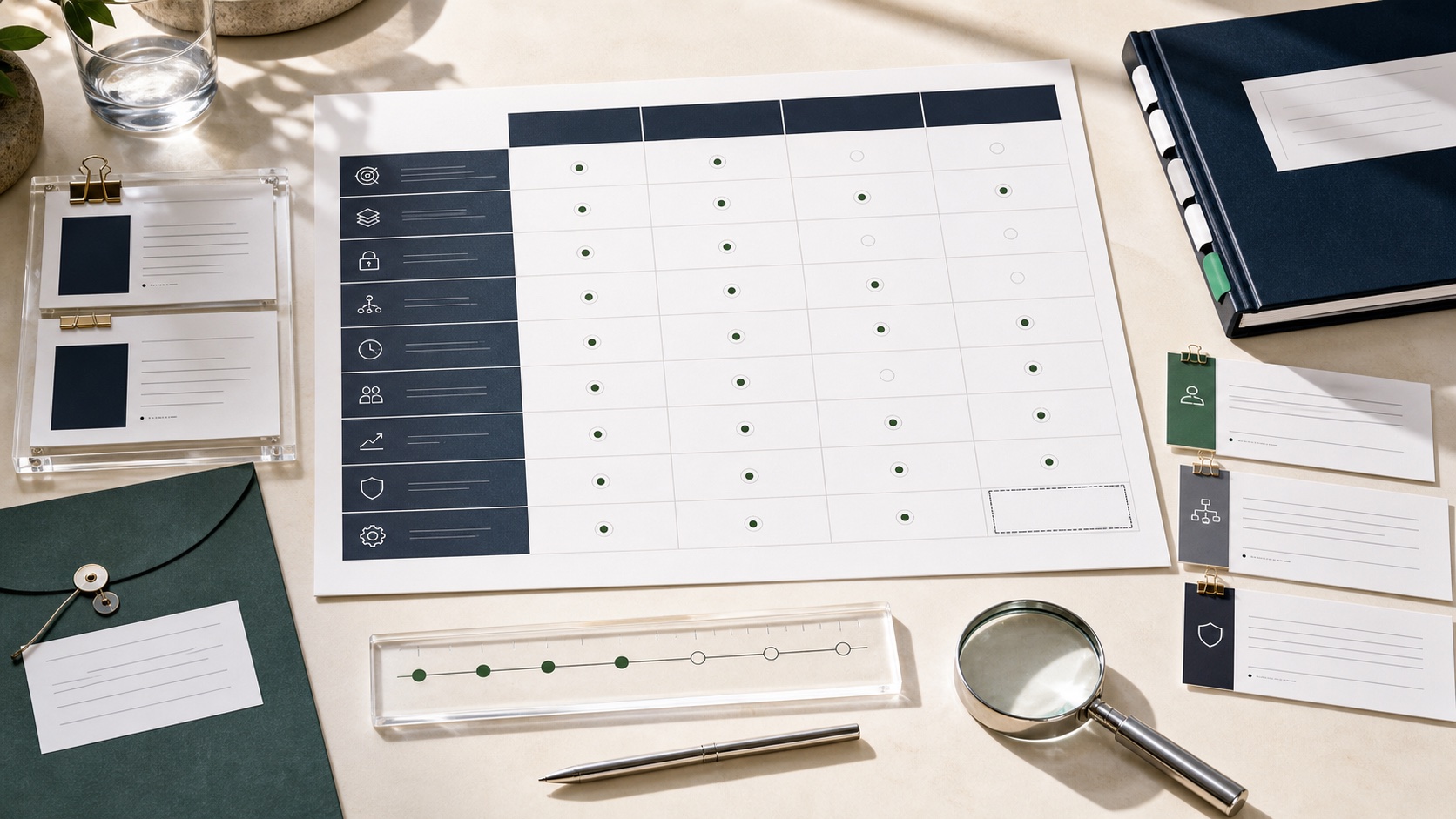
Business website platform decision map

Twelve controls. Four operating models. No automatic winner. This map forces the platform decision through the work a business has to carry after launch: publishing, application logic, data, forms, measurement, accounts, change control, and exit.

Open the map
A website platform decision map connecting business requirements to owned operations and measurable inquiry paths
This is a decision specimen, not a client-performance claim.
01 / How to use it

A working decision, not a personality quiz

Bring one owner from each affected function.

Use the map in a 60-minute platform review.
  • Bring the owner of marketing, sales or lead intake, operations, technology, and the domain or accounts.
  • Mark each control as required now, likely within 18 months, or not required.
  • Mark who owns the control after launch.
  • Reject any platform proposal that hides an essential control inside “custom work later.”
  • Record unresolved items as risks. Do not force a winner while a high-consequence risk remains unnamed.

Inputs

BUSINESS NEEDS

Not platform features copied from a sales page.

Decision owner

NAMED

Someone has authority to accept the operating burden.

Unknowns

VISIBLE

A blank is a risk, not a neutral score.

Output

CONTROL PLAN

Platform, owner, proof, exit, and review date.

Do not average away a fatal weakness. A platform that scores well on eleven convenient items can still fail because the twelfth item controls customer data, revenue, or the right to operate.

Specimen note 01: consequence outweighs feature count.

02 / Decision map

Start with the operating shape

Follow the work, then test the exit.

Business website operating-model decision flow

Decision flow for WordPress, Webflow, Lovable, and code-owned business websites The map starts by testing whether the current system works, then distinguishes publishing depth, visual-team operation, application logic, and focused code-owned marketing sites. Every path ends with ownership, measurement, and exit tests. FIRST QUESTIONDOES THE CURRENT SYSTEM FAIL A NAMED NEED? NO: REPAIR OR KEEPYES: IDENTIFY THE OPERATING SHAPE BELOW PUBLISHING DEPTHTEST WORDPRESS VISUAL MARKETING TEAMTEST WEBFLOW APPLICATION LOGICTEST LOVABLE OR APP STACK FOCUSED MARKETING SITE?ALSO TEST A CODE-OWNED BUILD REQUIRE OWNER + MEASUREMENT + EXIT PROOF
The arrows identify models to test, not automatic selections. A hybrid can be valid, such as WordPress for publishing plus a separate application, when ownership and customer routing remain explicit.
KEEPREPAIRSEPARATEREBUILD

Specimen note 02: “keep” is a legitimate result.

03 / Twelve controls

Score the operating burden

Fill this before comparing proposals.

ControlBusiness questionRequired now / later / noNamed ownerAcceptance proof
1. PublishingWho creates, reviews, schedules, updates, and retires content?__________Named editor completes a real change.
2. Visual systemHow much layout freedom does the team need without a developer?__________Team builds an approved page from components.
3. Application logicDo users log in, create records, calculate, transact, or complete workflows?__________Critical flow passes with test roles and data.
4. Content and dataWhat must be exported, retained, restored, and deleted?__________Export and restore sample pass.
5. Inquiry pathHow do calls, forms, bookings, orders, and quote requests reach the right person?__________End-to-end tests produce receipts.
6. Lead qualityHow are spam, wrong service, wrong geography, and qualified opportunities separated?__________Disposition fields and review cadence exist.
7. MeasurementCan the business connect source, landing page, action, and sales outcome?__________Events and outcome records reconcile.
8. IntegrationWhich systems exchange customer, product, inventory, payment, or scheduling data?__________Documented failure and retry tests pass.
9. Access and securityWho can see, change, deploy, and recover each part?__________Roles, secrets, logs, and recovery are verified.
10. Release controlHow is a change tested, approved, deployed, recorded, and reversed?__________One controlled release and rollback rehearsal.
11. Account ownershipDoes the business control domain, DNS, hosting, code, data, analytics, forms, and billing?__________Business-owned access is demonstrated.
12. ExitCan a different operator take over without rebuilding the business from screenshots?__________Transfer packet passes a cold handoff review.
QWhich failed control could stop revenue or expose customer data?

Specimen note 03: a required control marked untested blocks selection.

04 / Model cards

Test each option against the same controls

Four models. No immunity from operation.

Model A

WordPress

Prefer when: the business has a deep publishing need, a valuable installed site, or working WordPress skills and integrations.

Prove: update ownership, plugin governance, editor workflow, security, backups, performance, form delivery, and host portability.

Reject when: the proposal adds another opaque builder stack without correcting the business problem.

Model B

Webflow

Prefer when: a design or marketing team needs controlled visual production inside a managed platform.

Prove: editor permissions, CMS scale, localization, forms, integrations, price path, and the exact functional exit.

Reject when: “code export” is presented as complete portability without accounting for CMS, ecommerce, accounts, forms, search, or localization.

Model C

Lovable or generated app build

Prefer when: application behavior, authenticated workflows, stored data, and rapid product iteration matter.

Prove: repository ownership, architecture, database control, permissions, tests, deployment, logs, backups, and independent continuation.

Reject when: a fast prototype is treated as production proof or an existing site is assumed to import directly.

Model D

Code-owned marketing build

Prefer when: the public site is focused, speed and exact control matter, and the business has a named operator.

Prove: repository access, build instructions, editor path, hosting portability, forms, analytics, redirects, release checks, and handoff.

Reject when: “no platform lock-in” hides dependency on one undocumented developer.

Feature comparison

Every column gets checkmarks.

Feature tables reward the company that names the most capabilities. They do not reveal who carries the work or how the business exits.

Control comparison

Every required control gets an owner and a test.

The winning model is the one the business can operate, verify, and transfer at an acceptable cost.

Specimen note 04: tool capability is not business capability.

05 / Fit profiles

Examples, not client claims

How the map changes by business shape.

Local service company

Calls, forms, geography, proof

The public site is usually a focused conversion system. WordPress, Webflow, or a code-owned build can all work. The decision turns on editing, operator availability, form and call routing, location structure, measurement, and transfer.

Frequent mistake: buying application complexity while the phone number, qualification fields, and source capture remain weak.

Publisher or knowledge business

Editorial depth, archives, authors

A mature WordPress operation can remain the rational choice. Migration needs to beat the replacement cost of archives, taxonomies, contributors, search entry, and editorial habit.

Frequent mistake: treating hundreds of structured pages as copy blocks for a new visual design.

Portal or software-backed service

Users, records, permissions, workflow

Lovable or another application stack deserves testing. The marketing site can remain separate if that keeps publishing and acquisition simpler.

Frequent mistake: shipping generated application behavior without data ownership, role tests, logs, backups, and incident responsibility.

Campaign or focused offer

Speed, clarity, exact measurement

A code-owned page set or managed visual builder can fit. The value sits in the offer, evidence, inquiry path, experiments, analytics, and release speed.

Frequent mistake: allowing a temporary campaign stack to become an undocumented permanent website.

A business can use more than one model. It cannot use more than one truth about who owns the customer journey.Decision-map principle

Specimen note 05: separate systems when separation reduces risk and clarifies ownership.

06 / Proposal red flags

Stop the meeting here

Eight sentences that require proof.

  • ×
    “You will own everything.”Ask for the account list, repository, data export, build instructions, and exit demonstration.
  • ×
    “It is future-proof.”Ask which foreseeable requirements were tested and which changes would require a rebuild.
  • ×
    “We can migrate the content automatically.”Ask about structured fields, media, authors, dates, metadata, redirects, forms, data, and exceptions.
  • ×
    “The platform handles security.”Ask who owns application code, data access, user roles, secrets, dependencies, logs, backups, and incident response.
  • ×
    “Analytics will be installed.”Ask which qualified action is recorded, with which parameters, where it arrives, and how it connects to a sales outcome.
  • ×
    “The code can be exported.”Ask what does not export and how missing functions are rebuilt elsewhere.
  • ×
    “AI makes changes instant.”Ask how changes are reviewed, tested, approved, released, logged, and reversed.
  • ×
    “We recommend this for everyone.”End the meeting. A platform preference is not an operating diagnosis.
SHOW THE ACCOUNTSHOW THE TESTSHOW THE EXIT

Specimen note 06: claims become useful only after a demonstration.

07 / Source ledger

Evidence boundary

Sources used to set the model constraints.

This artifact applies those constraints to a business decision process. The twelve-control method and fit profiles are Stan Consulting’s owned work. They are not presented as third-party research or a universal scoring standard.

Source ledger reviewed July 19, 2026.

Use the map before paying for the rebuild.

Stan Consulting can turn the completed controls into a conversion-site build, migration ledger, measurement plan, and owned operating packet.

Bring the decision to Stan