
Fact check: the topic is real, the bragging is not all proven
The safe verdict: mostly true as a trend call, false if treated as a measured ranking. Late April through late May 2026 gave marketers a hard push toward AI agents, AI-assisted ads, and AI-generated creative. Google Marketing Live on May 20, 2026 was the cleanest timestamp. Google announced ad formats built with Gemini, AI-powered Shopping ads, Business Agent for Leads, Direct Offers with UCP native checkout, Universal Cart, Asset Studio updates, and Ask Advisor.
That does not prove this was the single heaviest marketing topic everywhere. "Heaviest" depends on whose feed, which category, and which measurement window. A serious page should not pretend otherwise. What is provable is enough: the largest ad platforms and no-code automation tools are making agents, creative generation, and chat-led lead capture practical for operators without engineering teams.
 Confirmed platform shift
Google, Meta, Make, Zapier, and HubSpot all describe agent or AI-assisted marketing workflows in official material.
Confirmed platform shift
Google, Meta, Make, Zapier, and HubSpot all describe agent or AI-assisted marketing workflows in official material.
 do it yourself path is credible
No-code builders can connect forms, sheets, CRMs, ad drafts, inboxes, and approvals without custom engineering.
do it yourself path is credible
No-code builders can connect forms, sheets, CRMs, ad drafts, inboxes, and approvals without custom engineering.
 Cheap video claims need proof
"Forty UGC ads for pennies" can mean raw generation cost. It does not include concept, edits, legal checks, failed variants, or wasted spend.
Cheap video claims need proof
"Forty UGC ads for pennies" can mean raw generation cost. It does not include concept, edits, legal checks, failed variants, or wasted spend.
 Control is the advantage
The team that wins is the team with approved claims, source files, review gates, and a clean test review.
Control is the advantage
The team that wins is the team with approved claims, source files, review gates, and a clean test review.
What people mean when they search for do it yourself agentic AI marketing
Most operators searching this topic are not looking for theory. They want one of four builds: a personal AI agent for marketing tasks, a no-code lead qualification agent, an AI UGC ad factory, or a content repurposing workflow that turns one source into posts, scripts, emails, and landing page notes.
Those are different jobs. A lead agent touches customer conversations. A content agent touches public claims. A UGC factory touches trust. A tracking agent touches the numbers the business uses to decide what to cut or scale. Treating all four as "AI marketing automation" is how the system gets messy fast.
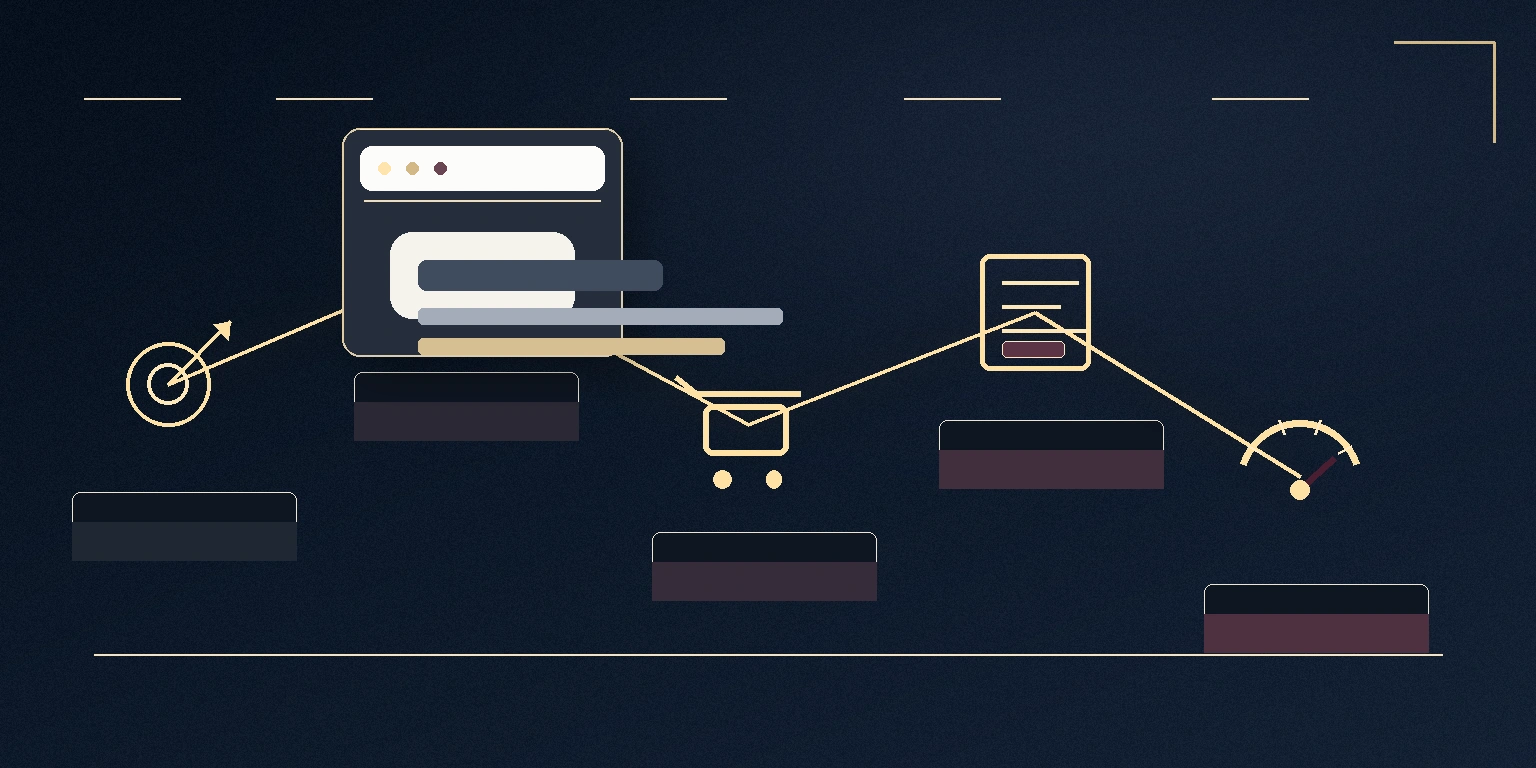
What agentic AI marketing means in plain operator terms
An agent is a workflow that can take a goal, use tools, remember context, and move a task forward without being prompted at every step. In marketing, that can mean a lead qualifier that checks a form and hands off the prospect, a content agent that turns source notes into draft posts, or a creative agent that produces ad scripts from product pages and customer objections.
The word that matters is access. Once an agent can touch your CRM, website, ad account, files, calendar, inbox, or lead handoff, it has operational power. That is why the first do it yourself build should be narrow. A small agent with good guardrails is useful. A giant agent with vague instructions becomes an unpaid intern with keys to the budget setting.
For most small teams, the right first version has no authority to publish. It prepares drafts, collects evidence, labels uncertainty, and sends the work to a human. The human approves the claim, chooses the creative angle, and decides whether the output deserves money behind it.
Build the first agent around intake, not output
The first agent should answer one question: what do we know well enough to say in public? That sounds less exciting than "generate 40 ads," which is exactly why it works. Most bad AI marketing starts with output before evidence. The page, offer, product, objections, proof, and customer language are scattered across tabs. The model fills the gaps with filler.
Build a source agent first. Give it a product URL, a notes document, approved customer language, product claims, pricing rules, audience notes, and platform restrictions. Its job is to return a claim-safe brief: what the product does, who it is for, what claims are approved, what proof exists, what objections need a response, and what must not be said.
Only after that brief exists should you generate hooks, landing page sections, email drafts, short-form scripts, or sales replies. The source brief is the brake pedal. Without it, the workflow can still produce a lot of content. It just may produce content that a lawyer, a buyer, or a platform reviewer will hate.
Use AI-generated UGC as a test rig, not borrowed trust
UGC-style ads work because they borrow signals from normal human behavior: a face, a phone camera, a direct sentence, a real objection, a small product moment. AI can imitate parts of that format. It cannot create a real customer experience. That line matters.
A useful AI-generated UGC factory tests variables. Hook one names the pain. Hook two names the failed workaround. Hook three names the product moment. The script changes the first three seconds, the objection, the proof order, and the CTA. The test asks which angle deserves a real creator, a real demonstration, or a paid media budget.
The bad version creates fake people who sound like customers, says they used the product, and buries the disclosure. That is not clever. That is a future account review sitting quietly in the corner.
The no-code tool stack by job, not brand
Do not start by choosing a tool logo. Start by choosing the job. A useful do it yourself stack has five roles: the model, the source file, the orchestrator, the creative tool, and the approval record. The brands can change. The roles should not.
The model checks and drafts. The source file holds truth. The orchestrator moves work between forms, sheets, docs, folders, CRMs, and notifications. The creative tool makes images, videos, voice drafts, or avatar rough cuts. The approval record shows which claims, scripts, disclosures, and variants a human cleared before spend.
Put approval gates where the damage happens
A marketing agent can make four kinds of mistakes. It can say something untrue. It can publish something unapproved. It can spend money on a weak premise. It can collect or path customer data in a way the team did not intend. These are not writing problems. They are control problems.
Use approval gates at the points where the agent touches public claims, paid spend, personal data, or customer conversations. A draft social post is low risk. A health claim, financial result, legal promise, fake review, synthetic spokesperson, or autonomous lead response is not low risk. The tool stack does not decide that. The operator does.
FTC guidance matters here. The FTC says businesses, agencies, public relations firms, review brokers, and reputation management companies can be liable for creating or selling fake or false reviews or testimonials. TikTok requires labeling for realistic AI-generated images, audio, and video. Meta has an AI labeling system for ads created or significantly edited with its in-house generative tools, and it gives more prominent labels to ads with AI-generated photorealistic humans.
If the asset needs the viewer to believe a real customer had a real experience, use real customer proof. If the asset uses AI to stage a scenario, disclose it and keep the claim tied to source evidence.
What to build this weekend
Build one agent, one source file, and one test batch. Do not connect publishing. Do not connect ad spend. Do not connect the agent directly to customers. The weekend version should make the human operator faster, not absent.
Use the source file as the agent's truth base. Include product facts, pricing, guarantee language, proof, claims you can substantiate, claims you cannot make, customer objections, platform policy notes, and examples of approved voice. If the source file is thin, the agent should say the source file is thin.
Then ask for 12 ad angles, not 40 finished ads. Pick three. Make three scripts from each. Produce rough creative only for the scripts that survive a human claim check. Spend the rest of the time making the best one stronger.
Starter prompt for a claim-safe marketing agent
Use this as the first instruction block. It is deliberately strict. You can make the agent more creative after it proves it can stay inside the fence.
You are a marketing prep agent. Your job is to prepare draft options for human review, not to publish or approve anything.

Use only the source material I provide. If a claim is not supported by the source, label it "needs proof" and do not write it as fact.

Return:
1. Approved product facts
2. Customer objections found in the source
3. Claims that are safe to use
4. Claims that need proof
5. Claims that must not be used
6. Twelve ad hook options
7. Three short UGC-style scripts that do not pretend to be real customer testimonials
8. A disclosure note if the creative uses AI-generated people, voices, or scenes
9. A human approval checklist before anything is published or used in an ad

Do not invent testimonials, customer outcomes, statistics, discounts, guarantees, credentials, awards, or product capabilities.
When to stop DIY
Stop when the agent is touching more than one business system and nobody can explain the failure path. Stop when the script needs a claim you cannot prove. Stop when the team is tempted to use a fake customer because the real proof is weak. Stop when a lead agent is answering pricing, eligibility, medical, legal, financial, or contract questions without a human review path.
The best use of agentic marketing for a small team is speed with control. The worst use is speed replacing judgment. The buyer can feel the difference faster than most dashboards can report it.
Sources checked for this guide
These sources support the factual frame. They do not support every social-media claim about cost, performance, or fully autonomous marketing services.
- Google Ads: A new generation of ads for the AI era of Search (May 20, 2026). Confirms AI-powered Shopping ads and Business Agent for Leads.
- Google Shopping: Universal Commerce Protocol features and AI tools (May 20, 2026). Confirms UCP, Universal Cart, agentic commerce, Merchant Center AI insights, and Ask Advisor for retailers.
- Google Ads: Asset Studio updates (May 20, 2026). Confirms AI-assisted creative asset generation, Gemini Omni video creation, and 1-Click A/B Testing.
- Make AI Agents. Confirms no-code AI agents built inside the Make canvas across connected apps and workflows.
- Zapier: AI agents for marketing. Describes marketing agents for content workflows, lead enrichment, research, and connected app actions.
- HubSpot Breeze AI tools. Confirms Breeze agents and AI tools across marketing, sales, and service workflows.
- FTC Consumer Reviews and Testimonials Rule Q&A. Confirms liability risk around fake or false testimonials, agencies, avatars, and fake indicators of social media influence.
- TikTok AI-generated content help page. Confirms labeling requirements for realistic AI-generated images, audio, and video.
- Meta: GenAI transparency for ads products. Confirms Meta's AI labeling approach for ads created or significantly edited with Meta generative AI tools.