Home / Services / Conversion Second Opinion

Service route - Stan Consulting

Find what is breaking in your marketing before you spend more.

The Conversion Second Opinion is a written outside review of the ads, website, store, tracking, offer, and follow-up before you spend more money on marketing. Send the URL, the ad account, and the actual problem. Stan Consulting reads the full sales path and writes the diagnostic naming what is breaking, in priority order. No discovery call. No retainer pitch.

Reviewed by Stan Tscherenkow Last Reviewed May 18, 2026

Founded 2019 Roseville, California Principal-led scope
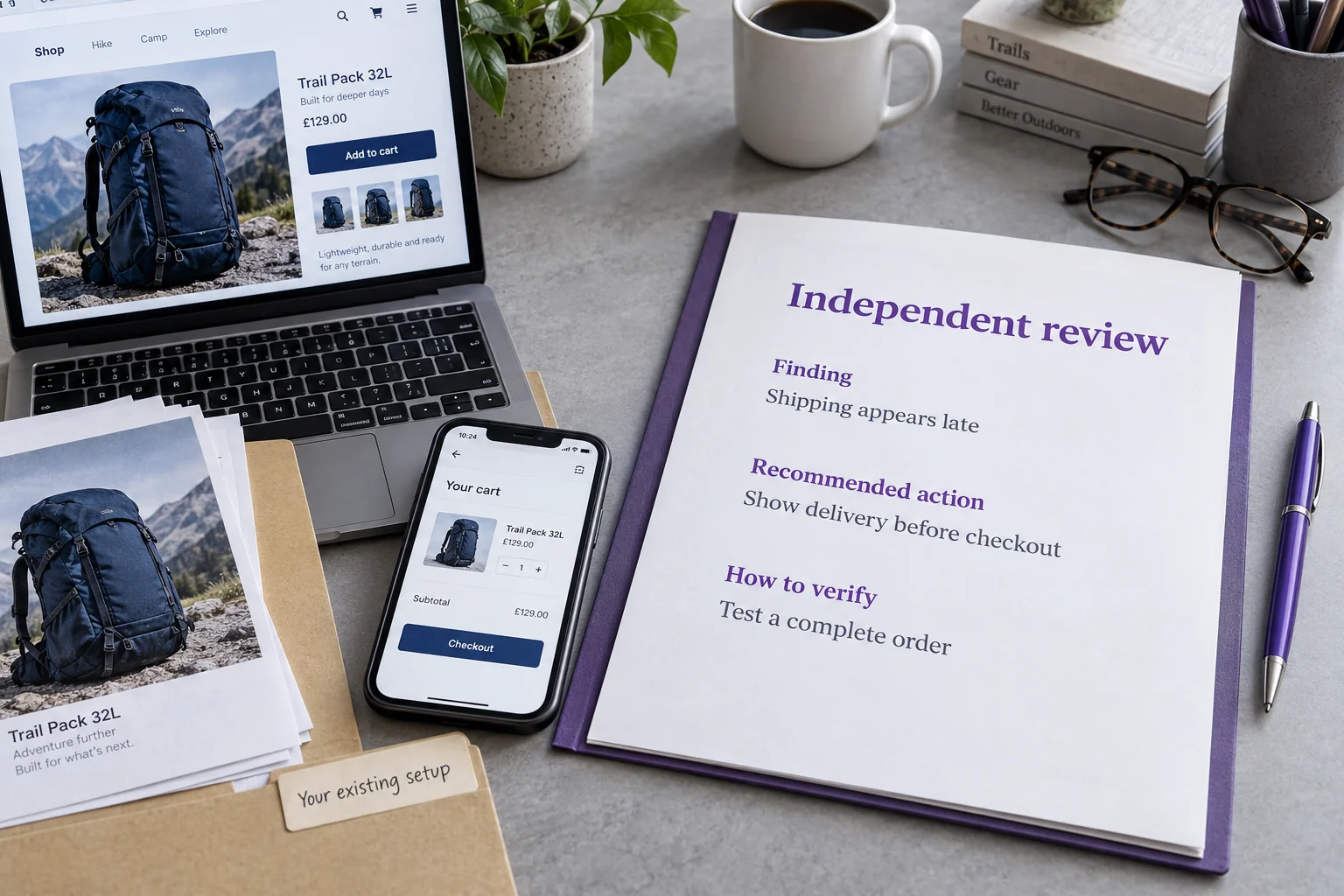
Conversion Second Opinion visual for paid marketing, website, store, or sales path work
Written diagnostic after intake calls, quote requests, purchases, booked work, or cleaner owner decisions

Key takeaways

What this page settles in one read.

Four premium 3D frames showing written diagnostic, full sales path, fix order, and buyer decision
Four outcomes, one written decision.
  • The deliverable is a written diagnostic, not a discovery call.
  • The work covers the full sales path: ads, page, form, tracking, offer, and follow-up. Not one channel.
  • The diagnostic names what is breaking, in priority order, before any rebuild or new spend.
  • The next step is a buyer decision, not a sales meeting. No retainer pitch. No upsell to another agency.

Before you buy

60-second prequalification.

A short form so Stan knows what you have before the payment lands. Submit goes to Stan, then opens the Stripe checkout. Both steps are needed; the work cannot start without context.

Active marketing surfaces · check all that apply
Submit sends context to Stan. The Stripe checkout opens after.

Offer clarity

What you can buy here.

Premium written diagnostic document receiving ads website store tracking offer and follow up evidence
The paid object is the written diagnostic.

Conversion Second Opinion is for owner-led companies before a hire, rebuild, pause, or vendor decision. The work is a written outside review of the ads, website, store, tracking, offer, and follow-up before you spend more money on marketing.

The page does not ask you to study a framework first. It gives you the commercial route, what is included, and the next step.

  • What is blocking the sale
  • What to fix first
  • Which route makes sense next
  • A written decision document

The framework

The Nine Leaks Diagnostic.

Nine premium diagnostic lenses around a website store and sales path
Nine places the sale can break.

01

Message clarity

Whether the page communicates what the business does, for whom, and why it matters in five seconds of scrolling.

02

CTA path

How many decisions stand between the visitor and the next step, where the path forks, and whether the primary action is obvious.

03

Form friction

Field count, required fields, validation noise, and what the form asks before the buyer has decided you are worth the answer.

04

Trust signals

Presence and placement of named clients, testimonials, case proof, certifications, founder identity, and address.

05

Mobile experience

Whether the offer, CTA, and trust signals survive a phone-sized screen, or whether they hide below three scrolls of layout.

06

Traffic source fit

Whether the traffic Google, ads, or referrals are sending is the audience the page was built for. Wrong-fit traffic is not a page problem.

07

Analytics integrity

Whether the events fire, whether the conversions count what they say they count, and whether the reports tell the truth.

08

Buyer objections

The specific questions the buyer has at the point of decision that the page does not pre-answer.

09

Sales follow-up

What happens between form submit and the first reply. Speed, format, named sender, and the first sentence.

Simple process

No maze. Three moves.

Three premium 3D stations showing submit evidence outside review and written decision
Send the evidence. Get the read. Decide.

Send the situation

Share the URL, campaign, store, page, or decision that should be producing calls, quote requests, purchases, booked work, or cleaner owner decisions.

Get the route

Stan Consulting reviews the situation and points the request to the right paid scope: review, repair, consulting, build, or advisory.

Move on the fix

You get the next step, owner decision, and implementation route without a vague exploratory call.

Decision lens

Conversion Second Opinion vs. agency audit vs. retainer engagement.

Premium 3D comparison of written diagnostic free agency audit and retainer cycle
A paid diagnostic is not a retainer trap.
AxisConversion Second OpinionFree agency auditRetainer engagement
What you receiveWritten outside diagnostic with named leaks and the fix orderDiscovery call follow-up tied to a retainer pitchMonthly execution work without an outside diagnostic
Deliverable formatWritten decision documentAudit document followed by a sales callTactical output on a monthly cycle
Who runs itPrincipal-led. The reader writes the diagnostic.Sales rep with a junior account teamAccount manager and execution layer
IndependenceYes. No upsell to a retainer.No. The audit precedes a retainer pitch.No. The retainer is the product.
When it fitsBefore any rebuild, pause, hire, or vendor decisionWhen the buyer is already shopping for an agencyWhen the direction is already chosen and execution is the gap
CoverageFull sales path: ads, page, form, tracking, offer, follow-upUsually one channel onlyWhatever the retainer covers
Price$999 one-time. Price visible. Paid up front.Free or low-cost as a sales toolMonthly retainer
Next stepBuyer decides what to do with the documentSales call to start a retainerNext monthly cycle

Why buyers trust the page

Clear scope before more spend.

Premium 3D proof stack for written diagnostic full sales path and principal led review
Written, full path, principal-led.
Written, not a call

The diagnostic ends with a written decision document. If a build or retainer is the right next step, it is named with the reasoning. If you should fix it internally with no SC engagement, the document says so.

Full sales path, not one channel

The work covers ads, page, form, tracking, offer, and follow-up. The leak is rarely where the last vendor was looking.

Principal-led

The same person who reads your account writes your diagnostic. No junior account team in between.

Questions before contact

What buyers usually need to know.

Buyer objections connected to a central written diagnostic document
The objections answered before contact.

Who is Conversion Second Opinion for?

It is for owner-led companies before a hire, rebuild, pause, or vendor decision. If there is no live offer, page, campaign, store, or decision yet, start with the contact form so the route can be scoped correctly.

What do we get?

You get what is blocking the sale, what to fix first, which route makes sense next, a written decision document, plus the next step that should happen first.

How much does it cost?

$999 is the visible starting point or pricing band for this service. Variable work is priced after the asset, account, timeline, and owner involvement are clear.

How fast can this start?

Written diagnostic after intake. Response comes through the quote request path after the context is submitted.

Do we need a call first?

Not as the first move. Submit the situation first so the conversation starts with the real page, campaign, store, or decision instead of a blank sales call.

What if we already have an agency or internal team?

That is common. The work can review the current setup, direct the internal team, or define what the outside vendor should fix first.

How is the Conversion Second Opinion different from a free agency audit?

A free agency audit is a sales tool. The deliverable is a discovery call. The Conversion Second Opinion is a written diagnostic. The deliverable is a decision document naming the leaks in priority order, with no retainer pitch attached. Engagement scope and fee, if any are recommended, follow the diagnosis. They do not precede it.

What does the diagnostic actually cover?

The full sales path. Ads, page, form, tracking, offer, follow-up. Not one channel. The report names what is breaking, ranks the fixes by revenue impact, and tells the buyer whether the next move is a rebuild, a partial repair, an internal fix, or a different problem entirely.

What does "optimizing" or "testing" mean when revenue is not moving?

It usually means one of three things. The tracking is broken so neither side knows what is working. The traffic source is sending wrong-fit buyers and no creative test changes that. Or the engagement is paid for activity rather than outcomes. The diagnostic reads which one is true in the account before the next cycle of spend.

What do we do after firing the current agency?

Send the URL, the ad account, the analytics, and the previous reports if they are available. The diagnostic reviews what actually happened, names what was breaking, and tells the buyer whether the next move is a new agency, an internal hire, a partial fix, or a different problem entirely.

What if the leak is not in marketing at all?

The diagnostic still tells the buyer. If the sales follow-up is the leak, the document covers that. If the offer itself is the leak, the document names it. If the audience is not who the page was built for, the document says so. The work covers everything between the dollar spent and the revenue received.

Can the diagnostic read whether the internal team is the issue?

The diagnostic reads the work product (the account, the page, the reports, the follow-up), not the people. If the work product is structurally sound, the team is delivering. If the work product has identifiable gaps, the diagnostic names them so the conversation with the team can happen with evidence.

What if a redesign is the right answer?

The diagnostic will say so. More often it is not the right answer. Most underperforming pages have a clear leak that does not require a full redesign. When a redesign is justified, the diagnostic names the specific reasons and ranks them so the rebuild brief is informed, not assumed.

External references

What the research says.

Premium external evidence board connected to a written conversion diagnostic
External evidence behind the sales path.
  • The average documented online shopping cart abandonment rate is 70.19 percent across 49 separate studies. The loss is checkout-side, not traffic-side. Baymard Institute
  • Users decide whether to stay or leave a web page within the first 10 seconds of arrival. Nielsen Norman Group
  • 75 percent of website credibility judgments are based on design and content cues. Stanford Web Credibility Project
  • B2B buyers complete most of the decision process before contacting sales. The page has to pre-answer the objection. McKinsey & Company

Get the right scope quoted.

Send the situation. Stan Consulting routes it to the right paid review, repair, consulting engagement, build, or advisory call.

Premium request payment and written diagnostic action path
The quote path stays simple.
Buy now · $999 · One-time