It removes the breaks between ad promise, product detail page, cart, checkout, tracking, and the second-purchase path.
Home / Services / Shopify Store Conversion Optimization
Stan Consulting service
Shopify Store Conversion Optimization When Traffic Is Not Turning Into Sales
$10M+Paid media. Managed.
200+Shopify stores. Built.
300+Websites. Shipped.
+703%One campaign. Public.
9Case files. Documented.
Updated July 4, 2026 · Shopify sales path checked · audit
Shopify store conversion optimization turns product visits into purchases by aligning traffic source, product page, cart, checkout, tracking, and post-purchase follow-up. Stan Consulting builds the store sales path so the buyer can trust the product, understand the offer, and complete the order without hidden friction.
Reviewed by Stan Tscherenkow Last Reviewed July 4, 2026
Founded 2019
Roseville, California
Principal-led scope

Need the answer fast?
Share the web address now, or jump to the part that answers the buying question.
Direct answer
Shopify store optimization turns product visits into purchases when the sales path is built as one system.
Short answer: Shopify conversion work is not only product-page design. The store has to connect traffic intent, product promise, price trust, cart clarity, checkout, purchase tracking, and repeat-purchase follow-up before more ads or theme work can pay back.
Fix conversion first when product interest exists but add-to-cart, checkout, purchase rate, or repeat purchase does not match the traffic quality.
Stan Consulting builds the store conversion system across product pages, cart, checkout, feed quality, and repeat purchase. See ecommerce brands, Shopify PPC, Shopify traffic with no sales, Marketing Atlas reference, the Shopify traffic guide, and the Shopify request form.
Basics before Shopify optimization
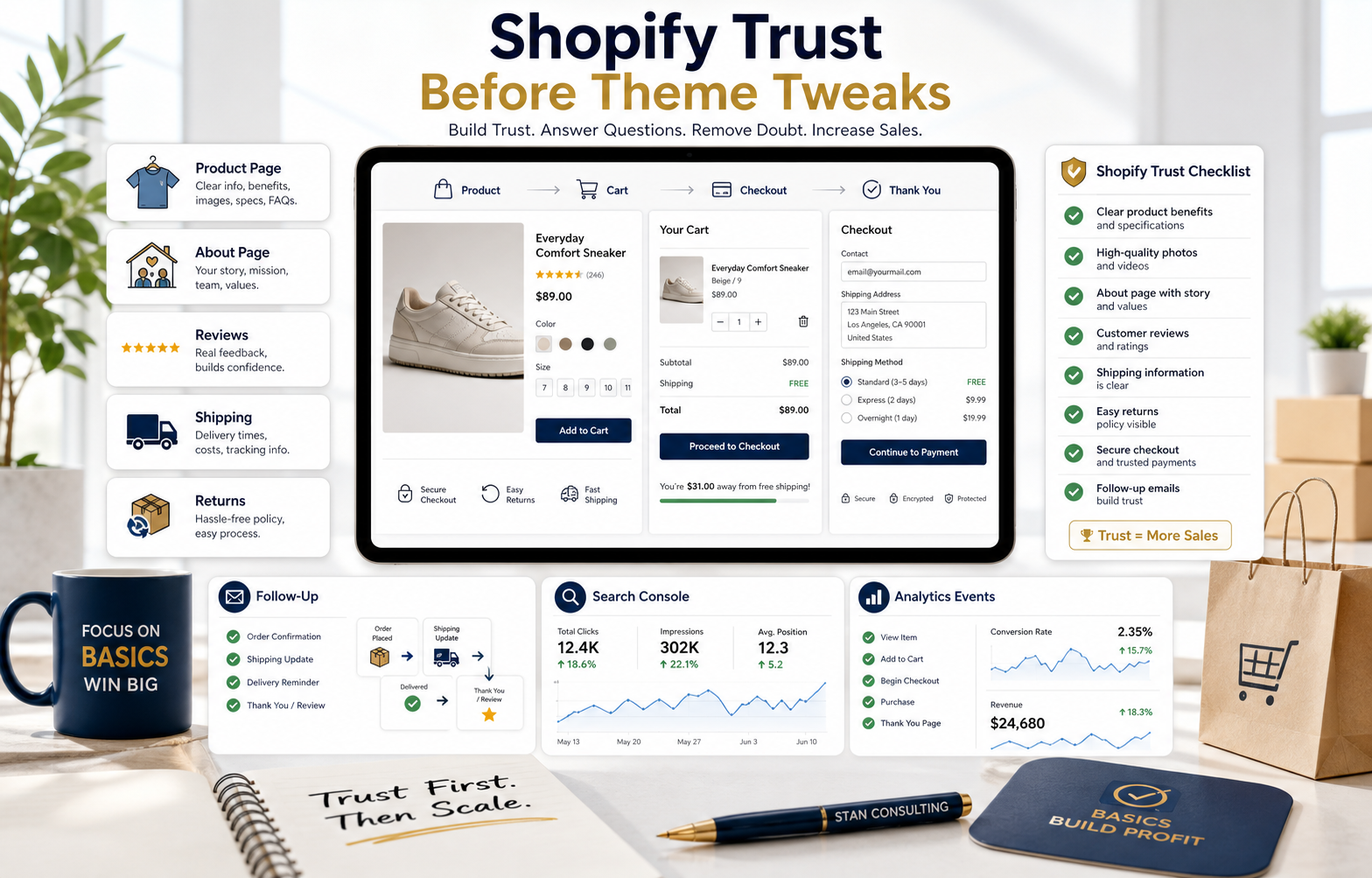
A Shopify store cannot convert trust the brand never built.
Product pages matter, but buyers still check the brand, reviews, policies, proof, shipping, returns, and whether the store feels alive before they buy.
Store basics before theme tweaks.
Stan Consulting checks the conversion path with the public trust layer, because checkout friction often starts before the cart.
- Google Business Profile, Apple Maps, Yelp, and BBB are claimed when they support trust for the brand.
- Product pages, about page, reviews, policies, founder signal, and customer proof answer checkout doubts.
- Search Console, Bing Webmaster Tools, data, pixels, product feeds, carts, checkout, and purchase events are clear.
- Social content shows real product use, people, process, behind the scenes, and customer context.
Decision point
Make the store path clear before more traffic.
For sites where traffic exists but the store is leaking buyer intent. Stan Consulting checks product pages, feeds, campaigns, checkout, and repeat-purchase signals as one commercial path.
Key takeaways
What you can decide before the next store build.
- Seven layers in the marketing services, not "improve the theme."
- Checks PDP, cart, checkout, tracking, and retention as one sales path.
- Baymard 70% abandonment baseline anchored; deviation is a structural signal.
- Written deliverable with build order. The marketing review carries no retainer.
- Paid Shopify store optimization is scoped after intake; larger stores require clearer access and priority order.
Offer clarity
What you can buy here.
Shopify Store Conversion Optimization is for Shopify stores with traffic, carts, or product interest that should turn into more purchases. The work builds the sales path across product pages, checkout, offers, trust, data, and paid traffic alignment.
You can see what is included, what decision it supports, and what to share next. It gives you the commercial decision, what is included, and the next action.
- Store friction mapping
- Product page fixes
- Checkout path notes
- Priority build list




The framework
The 7-Layer Shopify Revenue-path review.
01
Traffic-source intent vs catalog promise
Whether the visitor arrived ready to buy what the catalog is selling. PMax and Advantage+ routinely share the right impression count to the wrong intent.
02
PDP clarity and conversion architecture
Whether each product detail page answers the buyer’s silent questions before they click add-to-cart. The PDP is the conversion battlefield, not the homepage.
03
Trust signal density
Reviews, returns, security, social proof at the price moment. The structural answer to the question who else has done this safely.
04
Cart friction
Cart-page architecture, shipping clarity, upsell placement, abandonment triggers. The cart is the buyer's last checkpoint before commit.

05
Checkout friction
Form fields, account creation, payment options, mobile rendering, error states. One broken mobile validation can suppress revenue without appearing in desktop QA.

06
Tracking integrity
Whether Shopify, GA4, Meta Pixel, and Google Ads agree on what a sale is. Some apparent Shopify conversion failures are tracking problems rather than buyer-path failures.

07
Post-purchase retention path
Email, SMS, win-back, post-purchase upsell. For sustainable economics, conversion ends at the second purchase.
The method behind every engagement
The Stan Consulting Method™ · how this works
Stan Consulting maps the page, ad account, tracking, offer, and follow-up so marketing work starts from the right evidence.
- 01
Site
Landing page, message order, trust proof, and next action.
- 02
Account
Ad platform, campaign setup, landing page handoff, and spend.
- 03
Numbers
Tracking, attribution, the actual revenue trail.
- 04
Offer
What is being sold, the price, the proof.
- 05
Follow-up
What happens after the click, the form, the call.
Step 01Share the URLs and the account access.
Step 02Stan Consulting maps the marketing evidence.
Step 03You get the next marketing actions.
What people get wrong
What ecommerce brands get wrong about Shopify conversion.
The store is usually blamed after the ad account, theme, and analytics each give a different story. The useful work is finding which part of the sales path breaks the order.
A prettier theme cannot fix weak product proof, unclear shipping, mismatched traffic, broken events, or checkout friction.
ROAS can hide low-margin orders, one-time buyers, feed mismatch, and retention weakness. The store path has to explain order economics.
The bridge is the Shopify sales path: product page, cart, checkout, tracking, feed quality, and repeat purchase built together. Use Learn for practical checks or compare the build path with Shopify conversion build.


visual audit
The visual audit follows traffic from first click to purchase quality.
For Shopify and ecommerce pages, Stan Consulting checks the campaign, product page, feed, cart, checkout, and repeat-purchase path as one revenue system.
01Product signalProduct-page clarity, price trust, and SKU economics.
02Traffic signalGoogle, Meta, Shopping, and PMax intent quality.
03Checkout signalCart friction, attribution, and revenue quality.
Simple process
Three steps.
Use the intake path
Share the web address, campaign, store, page, or decision that should be producing calls, quote requests, purchases, booked work, or cleaner owner decisions.
Build the marketing plan
Stan Consulting maps the growth path and points the request to the right paid scope: service implementation, consulting, growth build, or marketing services.
Move on the build
You get the next action, owner decision, and implementation sequence without a vague exploratory call.
Decision lens
Shopify Store Conversion Optimization vs. conversion marketing plan retainer vs. theme rebuild.
| Axis | Conversion Optimization | conversion marketing plan retainer | Theme rebuild |
|---|---|---|---|
| What you receive | Store sales-path build order across PDP, cart, checkout, tracking, and retention | Monthly tests and a dashboard | A new theme, often with the same conversion problem |
| Fee structure | One-time, no retainer attached | Monthly recurring, 6-12 month minimum | $10K-$80K typical for service-business sites |
| Time to first deliverable | 72 hours after access | 4-8 weeks for first test | 6-16 weeks |
| Best when | Operator wants the layer named before committing | Layer is named, execution capacity is the constraint | Brand or visual identity is the actual problem |
| Worst when | Traffic, orders, economics, or product-market evidence are insufficient for the proposed work | Failing layer is upstream of the test layer | Failing layer is checkout, tracking, or retention |
| Steps to next | 30-Day Marketing Project, Shopify conversion system, or in-house fix list | Retainer extension or churn | Often a conversion marketing plan retainer to fix the new theme |
Why buyers trust the work
Clear scope before more spend.
Low CR is a symptom that compresses seven different structural causes. The growth plan names which layer holds the drop, not just the number.
Most Shopify reviews stop at the PDP. This one checks through checkout to retention because conversion economics end at the second purchase, not the first.

Industry benchmarks (Baymard 70% cart abandonment, Littledata segment data) frame the findings against real-world Shopify behavior, not against a theme aesthetic.
Questions before contact
Common questions.
Who is Shopify Store Conversion Optimization for?
It is for Shopify stores with traffic, carts, or product interest that should turn into more purchases. If there is no live offer, page, campaign, store, or decision yet, start with the request form so the request can be scoped correctly.

What do we get?
You get store friction mapping, product page fixes, checkout path notes, priority build list, plus the next action that should happen first.
How much does it cost?
Scope is set after intake. Variable work is priced after the store, traffic source, checkout path, timeline, and owner involvement are clear.

How fast can this start?
Response comes through the intake path after the store, traffic source, checkout path, and purchase constraint are submitted.
Do we need a call first?
Not as the first move. Submit the situation first so the conversation starts with the real page, campaign, store, or decision instead of a blank sales call.
What if we already have an agency or internal team?
That is common. The work can map the current setup, direct the internal team, or define what the outside vendor should fix first.
How is this different from Shopify ecommerce marketing?
Shopify ecommerce marketing covers the larger traffic, feed, paid media, and retention system. Shopify store conversion optimization focuses on the sales path inside the store: product pages, cart, checkout, trust, tracking, and the next purchase action.
What stores is this useful for?
Fit depends on qualified traffic, order volume, product economics, funnel evidence, implementation capacity, and decision value. Revenue alone does not decide the engagement.
How many PDPs are included?
Three priority PDPs of your choice as part of the 7-layer store path. If unknown, we pick by traffic share. Additional PDPs are scoped as add-ons or rolled into the build engagement.
Does this cover Shopify Plus checkout extensibility?
Yes. Plus stores typically have heavier checkout customisation; the checkout-friction review is more involved. Multi-storefront work is scoped after intake.
What happens after the growth plan?
The fix sequence ships in the written deliverable. Execution sits with your in-house team, your existing partner, or the Shopify Conversion Build engagement at Stan Consulting. The growth plan does not commit you to follow-on work.
External references
What the research says.
- Baymard's aggregated ecommerce cart-abandonment baseline is about 70 percent; diagnose change against the store's own comparable baseline. Baymard Institute · Cart Abandonment Rate
- PDP clarity, cart behavior, and checkout friction are the three highest-impact areas of Shopify conversion work. Shopify · Conversion Rate Optimization Guide
- Industry-specific Shopify conversion benchmarks vary by category. Store findings are interpreted against the relevant segment, not a global average. Littledata · Shopify benchmarks
- Mobile checkout completion gaps trace to specific structural elements (Shop Pay placement, address autocomplete, validation states) rather than general design. Baymard Institute · Mobile Checkout UX
This service answers these pains
If this describes the problem, these pages explain why.
Fit check
Best fit: best fit when the next marketing action can be shipped, measured, or handed to the team.
Bring the page, campaign, offer, tracking, and follow-up context. The growth plan shows which step is losing calls, quotes, orders, bookings, or sales.
The company has real demand, budget, or traffic, and can change the page, offer, proof, tracking, follow-up, or spend logic.
The useful move: the useful move is the one that improves the campaign, page, tracking, offer, or follow-up.
The web address, the offer, the ad or search source, the sales action that should happen, and what currently happens instead.
Find the Shopify layer before buying another fix.
Use the intake path when traffic, carts, product interest, and checkout behavior do not agree. If the leak is unclear, share the store context first.
Request a quote