UCP now appears on the storefront domain
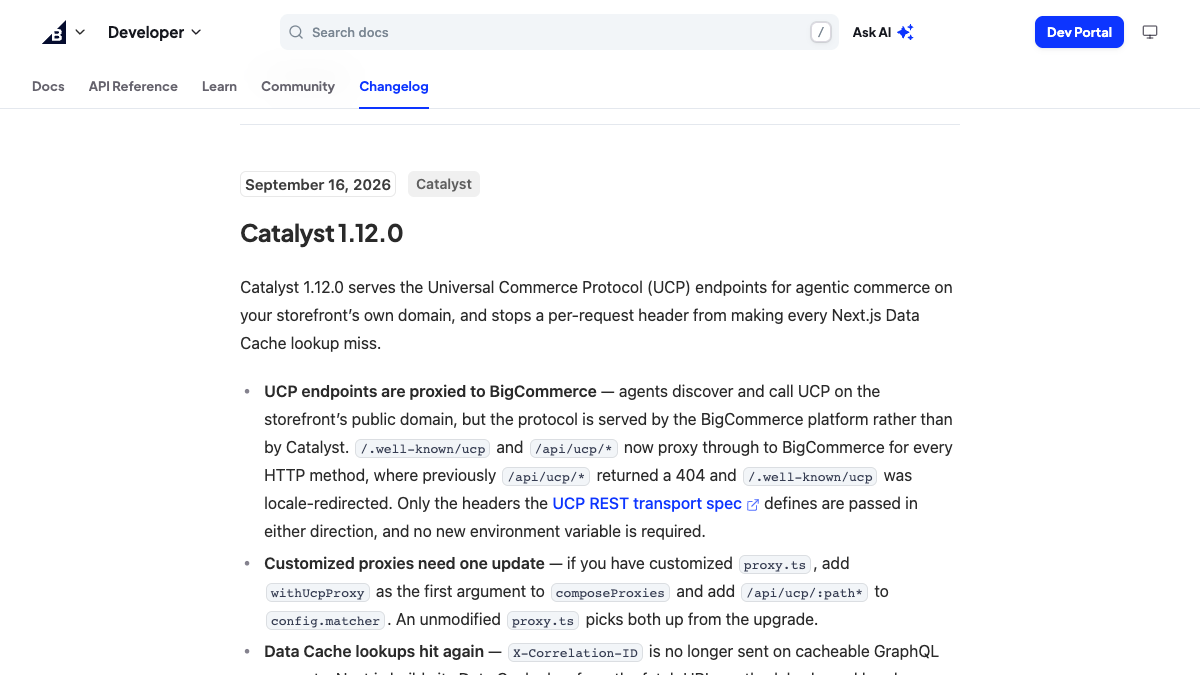
BigCommerce released Catalyst 1.12 on September 16. The storefront now proxies /.well-known/ucp and /api/ucp paths to BigCommerce so agents can discover the protocol on the store's public domain.
An unmodified proxy.ts receives the proxy handling through the upgrade. A customized proxy needs withUcpProxy added to the proxy composition and /api/ucp/:path* added to the matcher.
A changing header had defeated the data cache
Catalyst had attached a new X-Correlation-ID to cacheable GraphQL requests. Because Next.js includes headers in the cache key, each request looked unique and missed the existing entry.
Version 1.12 limits that header to requests that are already marked no-store or no-cache. Teams should compare origin request volume and cache hits after the upgrade instead of assuming the fix is active.
Protocol readiness and storefront speed need separate tests
The UCP endpoints support agent discovery and calls, while the header change addresses normal storefront data caching. They solve different problems and need different checks.
Our recommendation: verify the public protocol document and API endpoints, then run a second test for page data, cache behavior, and visible product accuracy.
For your next work session
What to check next
- Check whether proxy.ts has custom changes.
- Upgrade Catalyst in a preview environment.
- Verify /.well-known/ucp and /api/ucp paths on the storefront domain.
- Compare GraphQL origin requests and cache hits before and after.
- Test price, availability, cart, and checkout through the intended path.
Sources and scope
Unmodified proxy files receive the UCP changes through the upgrade. Customized proxies need a manual update. The release enables protocol endpoints and fixes cache behavior; it does not prove that an AI agent has completed a sale.
The announcement is confirmed by the source below. Practical checks in this article are Stan Consulting's recommendations.
Need help applying this to your business? Ecommerce marketing services.