It gives the platform clean conversion signals, sends the buyer to a page that matches the promise, and checks whether the lead or order is worth the spend.
Home / Services / Paid Advertising Management
Stan Consulting service
Paid Advertising Management Tied to Revenue Outcomes
$10M+Paid media. Managed.
200+Shopify stores. Built.
300+Websites. Shipped.
+703%One campaign. Public.
9Case files. Documented.
Updated July 4, 2026 · revenue signal checked · paid media step
Paid advertising management turns ad spend into qualified demand when the account, landing page, tracking, offer, and follow-up are managed as one revenue handoff. Stan Consulting builds that paid media system around the action the business needs: calls, quote requests, purchases, booked work, or sales conversations. Reporting connects spend and campaign decisions to those outcomes, with the next action and accountable owner recorded.
Reviewed by Stan Tscherenkow Last Reviewed July 4, 2026
Founded 2019
Roseville, California
Principal-led scope

Need the answer fast?
Share the web address now, or jump to the part that answers the buying question.
Direct answer
Paid advertising management turns budget into qualified demand when the full revenue handoff is managed.
Short answer: Paid ads work when the campaign, landing page, tracking, offer, and follow-up all point at the same commercial action. If the business needs calls, quotes, purchases, booked jobs, or sales conversations, the account cannot be managed apart from the page and sales flow.
Hire management when the account needs ongoing ownership and the business can change the landing page, tracking, offer, follow-up, or budget logic.
Stan Consulting builds the paid media system around account structure, landing page handoff, revenue tracking, and follow-up. See Google Ads management, ads not converting, home services marketing, Marketing Atlas reference, the search terms guide, and the paid ads request form.
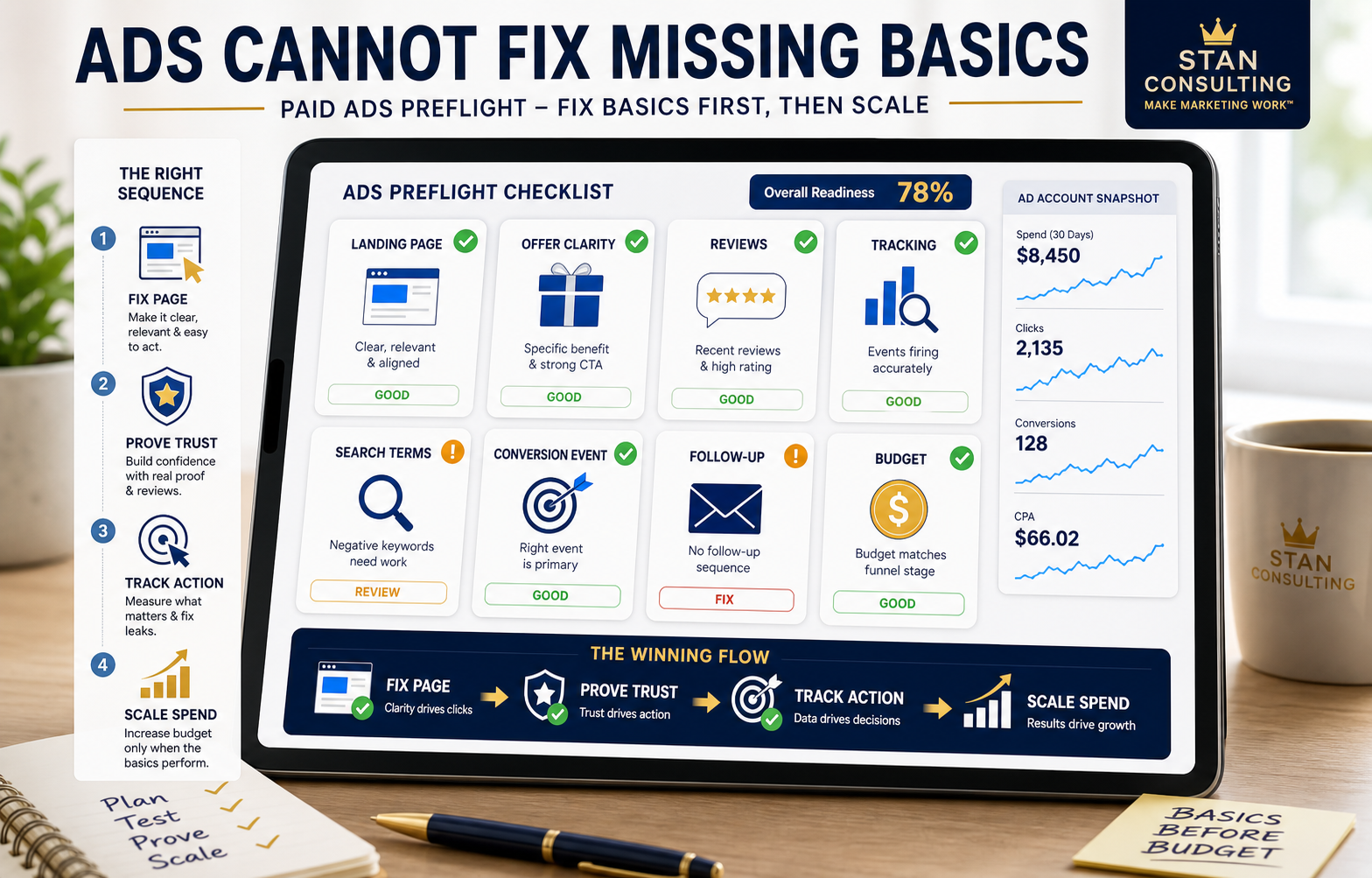
Basics before paid ads
Ad management cannot outbid a weak foundation.
More budget only makes the leak louder when the public profile, reviews, page, tracking, and follow-up are not ready for the traffic.
Fix trust before scale.
Stan Consulting checks the account with the page and the public record because buyers do not stay inside the ad platform after they click.
- Google Business Profile, Apple Maps, Yelp, and BBB are claimed, monitored, and aligned with the ad promise.
- Search Console, Bing Webmaster Tools, data, pixels, forms, calls, and revenue events are clean enough to trust.
- Landing pages, service pages, reviews, about page, founder signal, and case proof remove buyer doubt.
- Social channels show current work, people, story, and proof instead of a feed of recycled promos.
Decision point
Manage the account only after the revenue signal is clear.
For businesses that know the account needs ongoing ownership. If the leak may sit in the page, offer, tracking, or follow-up handoff, share the paid ads context before hiring management.
Recommendation fit
For buyers who need paid media ownership.
This is the step when the business needs ongoing account work tied to calls, quotes, purchases, booked work, and revenue quality. If the account is only one suspected leak, start with a growth plan first.
Who can manage ads when spend is not becoming revenue?
For accounts where ongoing campaign ownership is needed and the revenue signal can be measured cleanly.
Match the problemWho checks the ad account, page, and follow-up together?
For buyers who need account structure, search intent, landing page handoff, tracking, and lead quality in one pass.
Request a quoteWhat should we fix before increasing ad budget?
Use the paid step only after soft conversions, weak landing pages, and tracking gaps are named.
See paid ad proof
Not the right fit
Do not step here for impression growth, isolated bid tuning, or a dashboard cleanup. If the buyer cannot tell whether the leak is ads, page, offer, tracking, or follow-up, send them to the Conversion Marketing Plan.
Key takeaways
What you can decide before management.
- The work is tied to a real commercial action: a call, a quote, a purchase, or a booked job. Not impression volume.
- Account structure, search intent, landing page handoff, and tracking are reviewed before bid changes.
- Monthly tracking shows the buyer the cost of the action, not the click.
- Hire here when you know the account needs ongoing management. Start with a Conversion Marketing Plan if the failing part is unknown.
Offer clarity
What you can buy here.
Paid Advertising Management is for companies already spending or ready to spend on ads with a clear commercial target. The work is ongoing account ownership tied to qualified inquiries, and revenue quality.
It is not a default fix for every ad problem. If the account is getting clicks but sales are missing, Stan Consulting checks the account, page, offer, tracking, and follow-up before treating management as the answer.
- Account structure
- Search intent plan
- Landing page alignment
- Tracking that supports decisions




The framework
The Paid Media Marketing Services.
01
Signal integrity
Whether conversion tracking, server-side events, and offline imports are recording the action the business actually sells.
02
Account structure
Whether campaign, ad group, and audience structure match buyer intent or scatter spend across mismatched signals.
03
Search intent
Whether the search terms, match types, negatives, and PMax themes are paying for buyers or paying for browsers.
04
Landing page match
Whether the page the ad spends into answers what the ad promised, and whether the next action is obvious.

05
Revenue quality
Whether leads created by the account convert downstream into closed work, or look fine on the dashboard and die in the sales process.
The method behind every engagement
The Stan Consulting Method™ · how this works
Stan Consulting maps the page, ad account, tracking, offer, and follow-up so marketing work starts from the right evidence.
- 01
Site
Landing page, message order, trust proof, and next action.
- 02
Account
Ad platform, campaign setup, landing page handoff, and spend.
- 03
Numbers
Tracking, attribution, the actual revenue trail.
- 04
Offer
What is being sold, the price, the proof.
- 05
Follow-up
What happens after the click, the form, the call.
Step 01Share the URLs and the account access.
Step 02Stan Consulting maps the marketing evidence.
Step 03You get the next marketing actions.
What people get wrong
What businesses get wrong about paid advertising management.
The expensive mistake is treating the ad account as the whole system. The account can look cleaner while the buyer still lands on the wrong page, fills the wrong form, or disappears in follow-up.
Clicks, impressions, and soft conversions are useful only when they predict calls, quotes, purchases, booked work, or qualified conversations.
Bid changes cannot fix a weak landing page, missing proof, broken tracking, or a follow-up process that lets qualified demand go cold.
The bridge is the paid media marketing plan: account structure, landing page handoff, tracking, proof, and follow-up built around the revenue action. Use Learn for practical checks or share the context through Start.


visual audit
The visual audit checks the account, page, and sales flow together.
Campaign management is only part of the work. Stan Consulting looks at the ad account, the landing page handoff, and the conversion evidence in one view so the spend has a visible commercial decision.
01Spend checkCampaign structure, platform quality, and waste patterns.
02Page checkOffer match, proof, and next action after the click.
03Revenue checkTracking, lead quality, and what the business actually receives.
Simple process
Three steps.
Use the intake form
Share the web address, campaign, store, page, or decision that should be producing qualified inquiries.
Build the marketing plan
Stan Consulting maps the growth plan and points the request to the right paid scope: service implementation, consulting, growth build, or marketing services.
Move on the build
You get the next action, owner decision, and implementation sequence without a vague exploratory call.
Decision lens
Paid Advertising Management vs. Google Ads growth plan vs. in-house team.
| Axis | Paid Advertising Management | Google Ads growth plan | In-house team |
|---|---|---|---|
| What you receive | Ongoing account ownership with monthly tracking tied to commercial outcomes | One-time review of the account before any management work | Internal capacity controlled by hiring, training, and retention |
| When it fits | When the account needs ongoing senior judgment month after month | When the buyer wants a marketing plan before hiring or firing | When the volume of work justifies a full-time hire |
| Coverage | Search, PMax, Shopping, Display, Meta, and the landing pages the ads spend into | The account that was named in the intake | Whatever the team has bandwidth for |
| Tracking | Action-level monthly summary with named next decision | Single service request document | Internal tracking at whatever cadence the team produces |
| Price | Scoped after intake. Senior-led. | $999+ after scope review | Salary plus tools plus management overhead |
| Independence | External vendor with named principal | External marketing plan with no retainer attached | Internal |
| Next action | Monthly cycle continues | Buyer decides what to do with the document | Performance cycle and resourcing decision |
Why buyers trust the work
Clear scope before more spend.
every campaign is measured against qualified inquiries or booked jobs. Not impression growth and not platform-side conversion proxies.
Structure, search intent, landing match, and tracking integrity are assessed before any bid change. Bid optimization on a broken structure is wasted money.

Monthly numbers name the cost of the action, the change versus last month, and the next decision. No dashboard noise.
Questions before contact
Common questions.
Who is Paid Advertising Management for?
It is for companies already spending or ready to spend on ads with a clear commercial target. If there is no live offer, page, campaign, store, or decision yet, start with the request form so the request can be scoped correctly.

What do we get?
You get account structure, search intent plan, landing page handoff alignment, tracking that supports decisions, plus the next action that should happen first.
How much does it cost?
Scoped is the visible starting point or pricing band for this service. Variable work is priced after the asset, account, timeline, and owner involvement are clear.

How fast can this start?
Managed monthly. Response comes through the intake form after the context is submitted.

Do we need a call first?
Not as the first move. Submit the situation first so the conversation starts with the real page, campaign, store, or decision instead of a blank sales call.
What if we already have an agency or internal team?
That is common. The work can map the current setup, direct the internal team, or define what the outside vendor should fix first.
Is this the same as Google Ads paid search management?
Closely related. The Google Ads paid search management page covers Google Ads specifically. Paid Advertising Management is the broader scope: Google, Meta, paid social, and the landing pages. Pick the narrower page if Google Ads is the only surface in question.
What if the account is already running with another agency?
Submit the web address, the ad account access, and the previous numbers if available. Stan Consulting checks what is in motion before recommending a takeover, a parallel rebuild, or a service request first. Engagement scope is recommended after the assessment.
How is performance claimed?
Monthly tracking names the cost of the action (call, quote, purchase, booking) versus the previous month, the change attributable to specific account moves, and the next decision the buyer should approve. Dashboards alone are not the summary.
What if the leak is not only inside the ad account?
Often yes. The Conversion Marketing Plan is the outside marketing plan for the full sales flow before management is hired. If the leak is upstream of the account (offer, traffic source, follow-up), management work alone does not fix it.
What does the work cost?
Scope is set after intake. Variable work is priced after the asset, the spend band, the timeline, and the owner involvement are clear. Submit the situation through the paid ads request; the right scope is quoted back.
External references
What the research says.
- Conversion tracking is the foundation of every Google Ads decision. Broken tracking produces optimistic numbers and shrinking revenue at the same time. Google Ads Help · Conversion tracking
- Server-side event tracking reduces signal loss from browser-side restrictions and recovers attribution that the pixel alone misses. Meta Conversions API documentation
- Ad copy and landing-page mismatch is one of the most reliable causes of low conversion across paid channels. Nielsen Norman Group
- Search advertising benchmarks vary by industry by an order of magnitude. Generic conversion-rate targets are not useful without segment context. WordStream · Google Ads Industry Benchmarks
This service answers these pains
If this sounds like the situation, these pages are why.
Spend decision
Open the signal before scaling spend.
Short answer: Paid advertising management fits when the account needs ongoing ownership. If clicks, conversions, tracking, and revenue disagree, the first job is finding the leak before changing budget, bids, or vendors.
| Ad signal | Likely cause | Do not change yet | Money risk |
|---|---|---|---|
| Good CPC, weak ROAS | Traffic may be cheap but not qualified, or the page/offer may be breaking after the click. | Do not raise budget before checking intent, landing page handoff, and purchase/lead quality. | More spend can amplify low-quality demand. |
| Clicks but no sales or leads | The issue may sit in tracking, offer match, page trust, or follow-up. | Do not rebuild the campaign before checking the sales flow. | The account can look active while revenue stays flat. |
| Conversions claimed but pipeline is weak | The conversion signal may not match the action the business sells. | Do not optimize to the wrong event. | Platform learning improves toward bad data. |
Start with the buyer problem this service should solve. Open the matching problem.
Use the industry map when paid media economics depend on job value, sales cycle, and buyer urgency. See industries.
Use the result library before scaling spend that needs proof instead of platform optimism. See results.
Paid ad waste proof shows the kind of marketing evidence a buyer should inspect before the next spend decision. Open the proof.
If the leak crosses the account, page, offer, tracking, or follow-up, share the paid ads context before management. Send paid ads context.
Fit check
Best fit: a fit when the account, website, store, or intake form can actually be changed.
Bring the page, campaign, offer, tracking, and follow-up context. The first read shows where qualified demand is being lost before it becomes calls, quotes, orders, bookings, or sales.
The company has real demand, budget, or traffic, and can change the page, offer, proof, tracking, follow-up, or spend logic.
The business cannot change the account, page, store, tracking, offer, or follow-up yet.
The web address, the offer, the ad or search source, the sales action that should happen, and what currently happens instead.
Manage spend only after the signal is clear.
Share the account, page, tracking context, and commercial action that should improve. If the weak part is not clearly in the account, share the paid ads context first.
Request a quoteBuyer check
What to check before choosing this service
The service should be judged by the demand it captures, the page buyers reach, conversion tracking, lead or order quality, and the sales result after the click.
Good fit
Use it when the offer and sales capacity are clear enough to turn paid demand into qualified calls, quotes, consultations, or orders.
Check first
Before adding budget, check search or audience intent, campaign settings, landing-page match, conversion definitions, and follow-up.