Home/Problems/Marketing Consultant vs Marketing Agency

Service vs service · evaluator stage

MARKETING CONSULTANT
VS MARKETING AGENCY

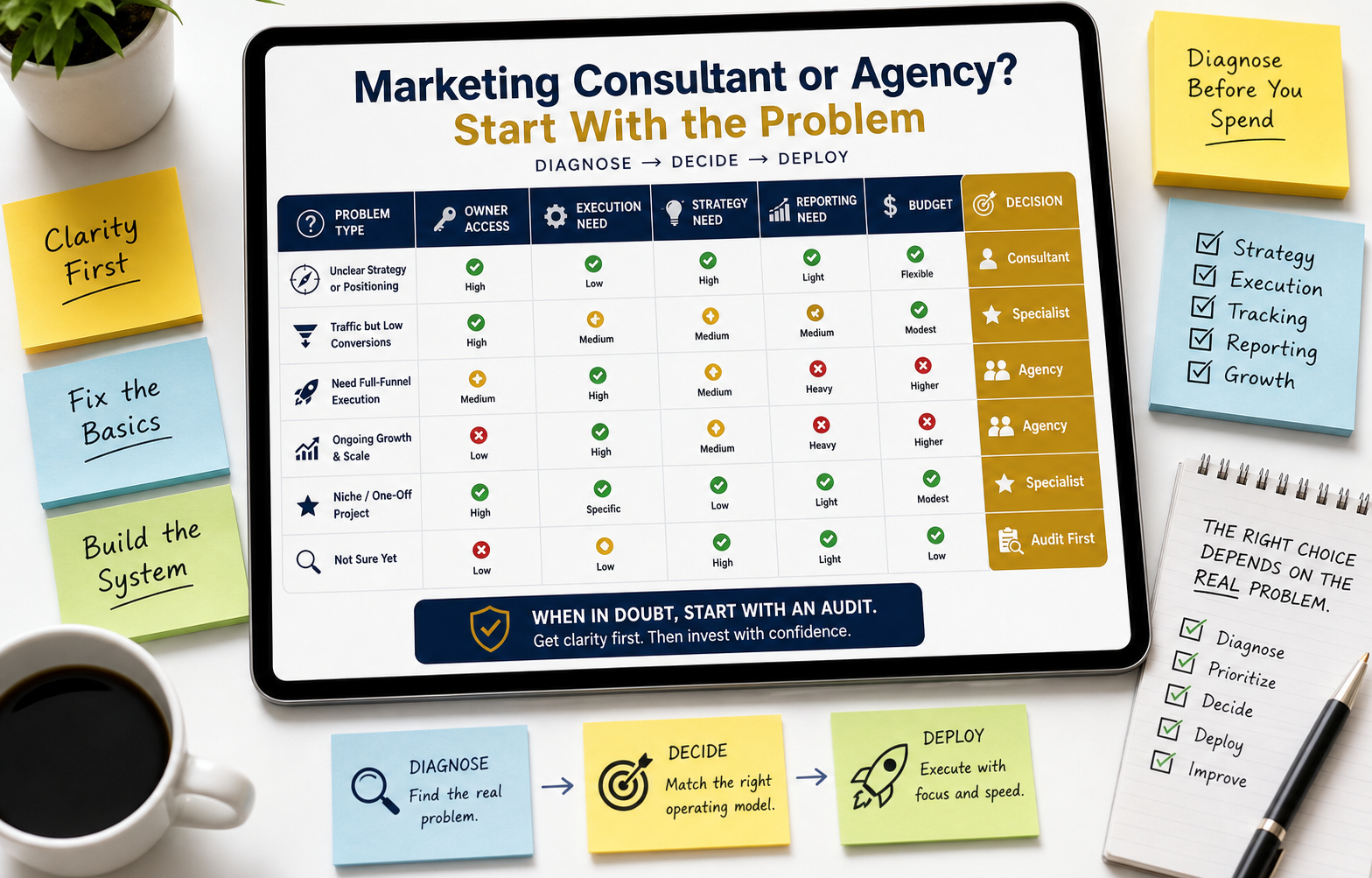
Marketing consultant or marketing agency? The difference matters for the operating model.

Consultants advise and produce written direction. Agencies execute at scale across channels. Buyers who hire one expecting the other create friction. The structural distinction is operational.

What this page covers

What this comparison covers.

  1. How Marketing Consultant actually differs from Marketing Agency
  2. Where each option wins and where each loses
  3. What buyers have tried that did not settle Marketing Consultant vs Marketing Agency
  4. The diagnostic that tells you which option fits your situation
  5. Stan's verdict
  6. Common questions before deciding

Four real differences. The marketing copy hides three of them.

Most comparisons of Marketing Consultant and Marketing Agency read like feature lists. The buyer is not deciding on features. The buyer is deciding which option fits the actual situation they are in. Four operational differences move the verdict.

Pattern

Consultants think; agencies do.

Consultants produce diagnosis, strategy, and documented direction. Agencies produce execution at scale: campaigns shipped, content published, ads optimized. Both can be excellent; the work output is different.

Pattern

Consultants engage; agencies retain.

Consultants run defined-scope engagements with clear endings. Agencies run ongoing retainers with continuous delivery. The commitment shape decides which fits the operator's budget rhythm.

Pattern

Consultants are senior; agencies are tiered.

Consultants are usually one senior operator. Agencies are typically a senior partner with mid-level account managers and junior executors. The buyer-side senior contact differs.

Pattern

Decisions sit on different sides.

Consultants recommend; the buyer decides. Agencies make execution decisions inside their scope; the buyer reviews. The decision-right boundary differs between the two relationships.

The right answer to Marketing Consultant vs Marketing Agency is not universal. The right answer is conditional on the buyer's situation. The diagnostic surfaces the situation; the comparison applies to it.Pattern observation · Stan Consulting

When Marketing Consultant wins. When Marketing Agency wins. The verdict.

Each option carries a buyer-situation profile. Match the buyer profile to the option and the comparison decides itself. Mismatch the profile and the decision drags through three meetings without closing.

Diagram · Marketing Consultant vs Marketing Agency decision panel
THE BUYER ASKS AI "Marketing Consultant vs Marketing Agency: which one for my situation?" OPTION A OPTION B Marketing Consultant WINS WHEN . buyer is at the structural-decision layer . category is mature and competitive . compound advantage matters more than speed LOSES WHEN . the other option matches better against the brief Marketing Agency WINS WHEN . buyer is at the execution layer with a defined brief . speed and scale dominate the brief . structural decision was already made elsewhere LOSES WHEN . the structural-decision layer is the actual gap VERDICT Consultants think. Agencies do. The operating model decides.

3-5x

Buyers who match the option to their situation profile see 3-5x better outcomes than buyers who pick on features or price alone.

The decision is conditional, not universal.

The diagnostic surfaces the conditions.

Pattern observation across SC reads

PETERS INTERRUPT

Read the structure.
Or pay for the leak.

Stan Consulting · operator observation

Comparison is not a feature war

MARKETING CONSULTANT OR
MARKETING AGENCY.

The right answer depends on which layer of the decision you are at. Get the layer wrong and the comparison gives you a confident wrong answer.

The numbers behind the shift

Where the funnel actually moves.

AI search 2025
30%
AI search 2024
12%
AI search 2023
3%
Classical search loss
50%

Source: Gartner forecasts + Adobe Digital Trends + Similarweb traffic data, 2024-2025.

Four phases. Thirty days.

01

Discovery

30-min call. Site audit. Citation baseline.

02

Buyer prompts

20-40 real queries captured. Engine tested.

03

Install

Schema, llms.txt, entity, content pages.

04

Measure

Citation re-measurement. Written report.

ENGINEERED. NOT EARNED.

Three rules. One install.

01

Buyer language wins citation. Category language loses it.

02

Schema beats content volume at the retrieval step.

03

Editorial citation compounds; reviews alone no longer originate.

When operators ask why their best work is not showing up in the AI answer, the answer is almost always that the AI cannot read what is not structured. The work is real. The signals are not.Stan Tscherenkow · Principal · Stan Consulting

Four moves that do not settle the comparison.

Buyers stuck between these two options usually try one of four moves first. Each move feels productive. Each one leaves the structural question unanswered.

What was tried

Marketing consultant wins when

  • You need diagnosis and direction, not execution
  • Senior outside expertise is needed for a specific problem
  • Project budget is bounded and the deliverable is a written plan
  • Execution capability already exists in-house
  • Decision speed is the operator's constraint, not the work volume

What closes the gap

Marketing agency wins when

  • You need ongoing execution across multiple channels
  • In-house execution capability is thin or absent
  • Retainer budget supports continuous delivery
  • Channel breadth requires specialists
  • Volume is the operator's constraint, not the strategic direction

The diagnostic. Six questions.

If three or more answers point the wrong direction, the pattern is structural, not effort-based.

  1. Do you need diagnosis or execution?
  2. What is the budget shape (project or retainer)?
  3. What is your in-house execution capability?
  4. How many channels need ongoing work?
  5. What is the operator's constraint (decision speed or work volume)?
  6. Is the work bounded or continuous?

Stan's take

The honest read. Consultants think. Agencies do. The operating model decides.

The consultant vs agency decision feels like a sourcing decision. It is actually an operating-model decision. The right answer depends on whether the marketing function needs thinking or doing.

Most operators below $5M revenue benefit from consultant + in-house executor. Most operators above $20M revenue benefit from consultant + agency executor + in-house leader. The middle is where the decision is most consequential.

What I tell operators who cannot decide: hire the consultant first. The consultant's engagement clarifies whether the in-house execution gap requires an agency or whether the gap is direction, not delivery.

Picking by price misses the operating-model fit. Picking by promise misses the structural reality. The fit decision is the one that compounds.

Stan Tscherenkow, Principal · Stan Consulting LLC

What operators ask before the first call.

Can a consultant and agency work together?

Yes. Common pattern: consultant for direction, agency for execution. The consultant scopes the work; the agency delivers it. The two coordinate at the strategy-meets-execution boundary.

Is a fractional CMO closer to consultant or agency?

Closer to consultant (one senior operator) but with agency-like ongoing engagement. Fractional CMOs occupy a middle ground that sometimes substitutes for either.

What is the price difference?

Consultants: $5K-$50K per engagement. Agencies: $5K-$50K/month retainer. The per-engagement vs per-month is the structural difference.

Can I switch from one to the other?

Yes. Many operators start with consultant for diagnosis, then transition to agency for execution. The handoff is structured by the consultant's written direction.

Next step

Decide between Marketing Consultant and Marketing Agency.

If the diagnostic above did not settle it, the structural read does. Stan Consulting reads your situation in 72 hours and writes the verdict.

Help me fix this