Skip to main content Stan Consulting LLC · Marketing Atlas · Agency Tracking Cadence

Marketing Atlas · Reference · Org Patterns

Agency Tracking Cadence.

Updated May 2026 · Reference page · written marketing audit

The frequency, format, and decision-orientation of an agency's client-facing numbers. The structural mismatch between monthly tracking cadence and weekly market shifts.

Concept · reference page Revised 2026-05-15 Author Stan Tscherenkow

Citation answer

What should a paid media agency summary, and how often?

A paid media agency should summary weekly on decisions and monthly on commercial outcomes. The weekly note should name spend changes, losing campaigns, tests started, tests stopped, and the next decision needed from the client. The monthly summary should reconcile spend, revenue, CAC, MER, margin, and the decisions made since the last summary.

If the agency only sends a monthly slide deck, the client is usually seeing a retrospective document, not an operating cadence. The problem is not the deck. The problem is that the summary arrives after the media market has already moved.

Foundation check

Basic operating cadence.

A useful agency summary is not a monthly performance story. It is an operating rhythm. The client should know what changed, what failed, what needs a decision, and what the next spend move depends on.

WeeklyDecision notes: spend changes, losing tests, winning tests, blockers, and client decisions needed now.
MonthlyCommercial assess: spend, revenue, CAC, MER, margin, lead quality, and what changed since the prior summary.
QuarterlyScope decision: keep, repair, pause, or change the engagement based on evidence, not presentation polish.
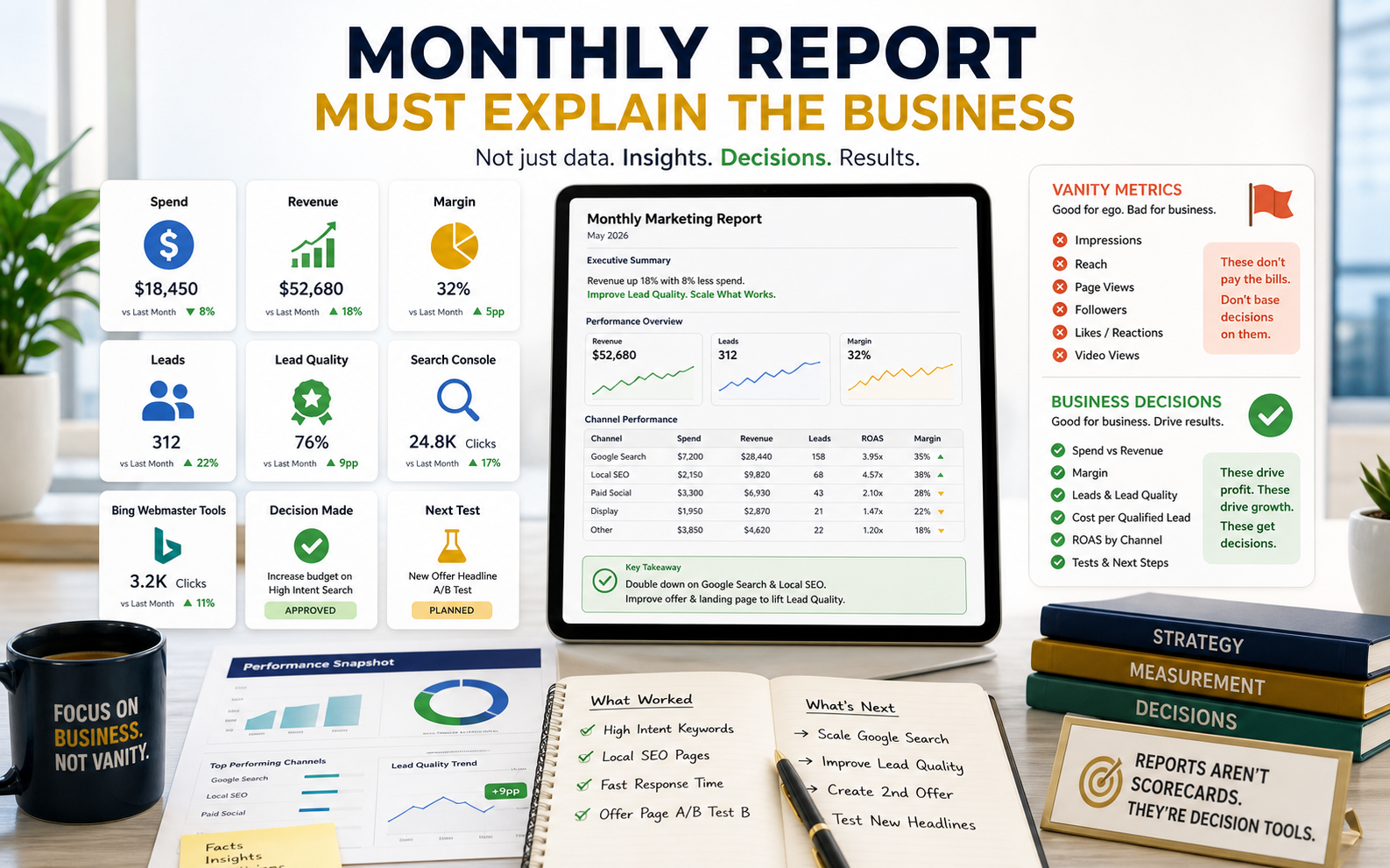
Generated bright tracking cadence visual showing spend, revenue, margin, leads, lead quality, search data, decisions, and next tests
Generated tracking cadence visual: tracking rhythm tied to revenue, lead quality, and the next operating decision.

Marketing Audit bridge

The summary should force a decision, not decorate the retainer.

Reference use: Use this page when the agency sends numbers, but the business still cannot tell what changed, what was learned, who owns the next move, or whether spend should continue. The issue is not the existence of a summary. The issue is whether the summary arrives early enough to protect the next decision.

Concept signalBusiness problemNext checksNext step
Symptom matchAgency, vendor, retainer, or outsourced marketing spend is not producing a clear return.Compare the concept to the visible business symptom before changing the channel, page, or budget.See the problem
Proof needThe idea needs evidence before it becomes a work order.Review the closest proof file for the same failure pattern.Review proof
Execution laneThe failing layer appears specific enough to scope work.Use a service page only when the constraint is named.See marketing audit
Unknown layerThe account, site, offer, tracking, or follow-up path may still be the leak.Get the written marketing audit before another rebuild, retainer, or budget increase.Get a Quote

The operating pattern underneath

What cadence changes in the account.

Monthly default · holdover from retainer-era
Weekly markets · quarterly decisions
PDF format · not decision artifact

The shift this concept produces

Before and after the operator changes the tracking cadence. Qualitative decision diagram, not a performance claim.

Before applying this concept
retrospective
After applying this concept
decision-ready

Section 01 · Quick definition

Definition.

In one pass

Agency tracking cadence is the rhythm at which an agency delivers performance information to its client, the format that information takes, and the decisions the cadence is built to support. Most agency engagements default to a monthly PDF or slide deck reviewed in a thirty-minute call.

The structural assessment

The default is a holdover from the retainer era when the data was hard to assemble. The market the agency is buying media in moves on a weekly cycle. The mismatch is structural, predictable, and the most common tracking failure in operator marketing.

Section 02 · Why it matters

Why it matters.

01

Origin.

Tracking cadence determines what decisions can actually be made. A monthly cadence locks the operator into making one consequential decision per month about a media program that has thirty operational decisions to make in that window. By the time the monthly summary identifies that a campaign is underperforming, the campaign has been underperforming for three to five weeks, the budget has flowed, and the next decision window is another month away.

02

Mechanic.

The cadence is also what determines the summary format. Monthly cadence pushes the summary toward retrospective narrative: a polished PDF that summarizes what happened, attributes credit, and confirms the agency was busy. Weekly cadence pushes the summary toward decision artifact: a short list of what changed, what to fix, what to test next. The two formats serve different purposes. Most agency engagements produce the first and call it the second.

The load-bearing point

The practical stake is that an operator paying retainer fees against a monthly cadence is buying retrospective numbers, not real-time decisions. The cadence is the governance layer of the agency relationship and is almost always under-specified in the contract.

Section 03 · How it runs

How agency tracking cadence is set and why it persists.

Tracking cadence is set in the first thirty days of the engagement and rarely changes. The default is monthly because monthly is what the agency's operations are built to produce, monthly is what the deck template was designed for, and monthly is what fits the client's account-management calendar. The weekly check-in, when it exists, is a Slack message rather than a structured summary. The quarterly business review covers strategy. The monthly review covers tactics. The actual decision pace of the media falls in between and goes unmet.

01

Step one · the cadence is inherited

The new agency relationship adopts the cadence the previous agency used because changing cadence requires a structural conversation that the new relationship is too early to have. The monthly format is treated as standard. The standard is a settlement, not a choice.

02

Step two · the format follows the cadence

A monthly cadence supports a thirty-slide PDF. A weekly cadence cannot. The PDF format encodes a retrospective stance, with executive summary, performance review, channel detail, and recommendations. The format does not produce decisions; it produces a record of decisions already made.

03

Step three · the meeting confirms the format

The monthly review meeting walks through the deck for thirty minutes. The deck dictates the meeting agenda. Questions outside the deck's structure get deferred. Decisions outside the deck's frame get parked for the next month. The meeting reinforces the cadence.

04

Step four · the decision lag compounds

By the time the monthly summary identifies a problem, the problem has been compounding for three to five weeks. The recommended fix is implemented in the following month, after which the summary on that month identifies the next problem. The tracking cadence becomes the decision cadence, and the decision cadence is two to three weeks behind the market.

The shift this concept names

Agency tracking cadence is the rhythm at which an agency delivers performance information to its client, the format that information takes, and the decisions the cadence is built to support.

Before applying this concept

“A weekly Slack update solves the cadence problem.”

After applying this concept

By the time the monthly summary identifies a problem, the problem has been compounding for three to five weeks. The recommended fix is implemented in the following month, after which the summary on that month identifies the next problem. The tracking cadence becomes the decisio...

Section 04 · Common misunderstandings

What people get wrong.

Misunderstanding 01

“A weekly Slack update solves the cadence problem.”

A weekly Slack update is a status check, not a decision artifact. It does not have the structure to surface what changed, what to fix, and what to test next. The cadence problem is solved by a structured weekly summary, not by adding Slack messages to a monthly review schedule.

Misunderstanding 02

“Monthly is the industry standard, so it must be working.”

Monthly is the industry standard because it is what the deck template, the account-management calendar, and the retainer billing cycle were designed for. The standard is an accident of operations, not a result of decision-quality optimization. Operators who switched to weekly decision cadence routinely summary the same agency producing very different outcomes.

Misunderstanding 03

“Quarterly business reviews fill the strategic gap.”

Quarterly business reviews discuss strategy. They do not change the weekly tactical decision pace. A QBR can identify that the monthly cadence is too slow without producing any change in cadence, because the cadence is a structural feature of the engagement, not a topic for review.

Misunderstanding 04

“The agency would summary more often if we asked.”

Most agencies will agree to summary more often and then revert to monthly within ninety days. The revert happens because the operations, the deck, and the meeting calendar all point monthly. Increasing cadence sustainably requires the agency to redesign its production process, which is a contractual change, not a meeting request.

Misunderstanding 05

“Decision-quality numbers are expensive to produce.”

Decision-quality numbers are shorter than retrospective numbers. A weekly decision artifact can be one page with five lines: what changed, what is on track, what is off track, what is being fixed this week, what is being tested next week. The expense is in the deck format, not in the decision format.

Section 05 · Marketing Audit questions

Questions a Stan Consulting marketing audit asks.

What is the contractual tracking cadence with the agency, and what is the actual tracking cadence?

01

What is the contractual tracking cadence with the agency, and what is the actual tracking cadence?

02

How many days elapse between a campaign starting to underperform and that fact being raised in a structured client summary?

03

Is the monthly review producing decisions, or is it producing a record of decisions already made?

04

What format is the weekly cadence in: structured one-pager, Slack thread, or no formal cadence at all?

05

Are creative test results, budget reallocations, and audience changes communicated within seven days of the change?

06

Does the operator know on Monday morning what last week's spend produced, or does that view appear weeks later?

07

If tracking cadence were changed contractually to weekly decision artifact and quarterly strategy, would the agency push back or build to it?

Stan's take . four chunks

01

Monthly tracking served the agency's economics, not the client's decisions.

02

The cadence was set when the data was hard to pull and the deck took three days to build.

03

Both of those constraints are gone.

04

The cadence persisted because the deck template, the account-management calendar, and the retainer billing cycle all point monthly. Operators who change cadence to a weekly one-page decision artifact and a quarterly strategy review almost always discover that the same agency is capable of running a sharper program. The cadence was the constraint. The agency was the same agency the whole time.

Stan Tscherenkow · Principal · Stan Consulting LLC
Cadence decision

Operating map

Match the summary cadence to the decision cadence.

A monthly deck can still be useful as an archive. It cannot be the only operating signal when spend, leads, tests, page fixes, and sales follow-up move every week. The summary rhythm should tell the owner what changed, what decision is due, who owns it, and when the next check happens.

Agency tracking cadence decision map A weekly decision note feeds the monthly review and quarterly strategy review. CADENCE BEFORE DECK Signal what changed Decision what moves Owner who acts Deadline when checked Weekly decision note Monthly commercial review Quarterly strategy call
Decision rhythm: weekly signal, monthly commercial review, quarterly strategy reset.
Question the summary must answerCadence that fitsDecision it should trigger
What changed this week?Weekly decision notePause, keep, fix, or test the next move before spend drifts.
What did the spend buy?Monthly commercial reviewJudge lead quality, booked work, revenue path, and next budget level.
What is blocked?Weekly owner checkAssign the blocker to agency, owner, sales team, site, offer, or tracking.
What changes next?Quarterly strategy resetChange offer, channel mix, page architecture, market focus, or retainer scope.

Weak move

Wait for the monthly deck to discover a leak that affected the last four weeks.

Better move

Use weekly decision notes, then make the monthly review a commercial judgment instead of a slide tour.

Decision rules

  1. Set the weekly signal. Every active channel gets a short decision note before the next week's spend moves.
  2. Keep the monthly review commercial. The meeting judges money, lead quality, blockers, and owner decisions.
  3. Use quarterly for strategy. Market, offer, channel mix, and retainer scope belong in the strategic reset.

SignalOwnerDeadline

A cadence problem is solved when the owner knows what changed, what decision is due, and who owns the next action before the next spend cycle begins.