A page structure that answers who this is for, why trust it, what happens next, and what proof supports the ask.
Home / Services / Business-to-business lead generation
Business-to-business consult and proposal path - Stan Consulting
Business-to-business demand generation for Qualified Sales Conversations
$10M+Paid media. Managed.
200+Shopify stores. Built.
300+Websites. Shipped.
+703%One campaign. Public.
9Case files. Documented.
Updated July 4, 2026 · page-specific generated visual · principal-led scope
For business-to-business and professional-services companies where interest exists, but the path from proof to consult request, qualification, proposal, follow-up, and close is too loose. The goal is not more forms. The goal is a sales path a serious buyer can trust.
Founded 2019
Roseville, California
No retainer required to start
Need the answer fast?
Share the web address now, or jump to the part that answers the buying question.
Decision point
The lead system has to help the buyer decide before the proposal is sent.
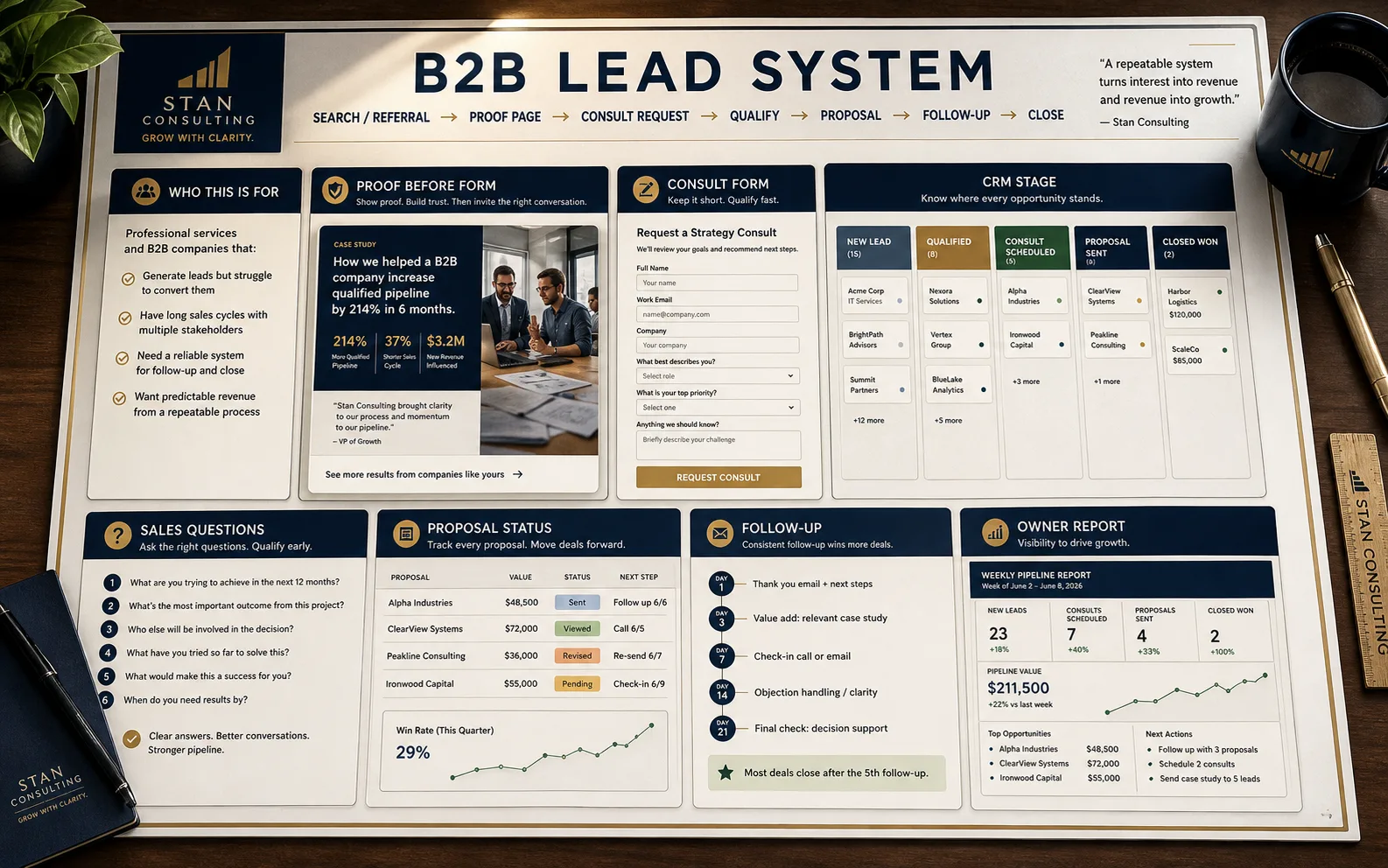
This step connects proof, consult request, sales questions, sales stages, proposal status, follow-up, and owner visibility so the business can see where deals are slowing down.
What gets fixed
The sales path, not just the page or tool.
The work starts where the buyer is already showing intent, then repairs the handoff to the next commercial action.
A short form and sales-question sequence that starts the conversation with useful context.
sales stages, proposal status, follow-up sequence, objection notes, and owner summary.
Setup checklist
Use this checklist before more traffic, tools, or outreach.
01 · Buyer signal
Search, referral, comparison, partner, event, outbound reply, or direct recommendation.
02 · Proof page
Case proof, specific outcomes, constraints, who it is for, and why now.
03 · Consult request
Short form, priority question, timeline, role, company, and fit signal.
04 · Pipeline
New, qualified, consult scheduled, proposal sent, waiting, won, lost.
05 · Owner summary
New leads, consults, proposals, follow-up due, close reasons, and blocked deals.
Do not buy this if
Wrong-fit work creates more activity without a better decision.
This step is for improving the decision sequence, tracking, handoff, and follow-up around real buyer action.
If the service, product, price signal, availability, scope, or next action is not ready, the first job is offer clarity.
The system must create decisions: what to build, who follows up, what happened, and what should happen next.
Questions before contact
What owners usually ask before this step starts.
Is this lead generation?
This is not positioned as generic lead generation. It is the system between buyer interest, proof, consult request, qualification, proposal, and follow-up.
Who is this best for?
Professional services, business-to-business services, manufacturers, distributors, and expert-led companies where one qualified opportunity is worth protecting.
What comes first?
Map the current sales path and proposal follow-up before adding more traffic or outbound volume.
Fit check
Best fit: a fit when the account, website, store, or intake path can actually be changed.
Bring the page, campaign, offer, tracking, and follow-up context. The growth plan shows which step is losing calls, quotes, orders, bookings, or sales.
The company has real demand, budget, or traffic, and can change the page, offer, proof, tracking, follow-up, or spend logic.
The useful move: numbers and meetings help only when the page, account, store, or intake problem is named.
The web address, the offer, the ad or search source, the sales action that should happen, and what currently happens instead.
Show the lead path.
Share the proof, consult form, proposal step, or follow-up gap. The sales break gets named before more outreach.
Request a quoteBuyer check
What to check before choosing this service
The service should solve a named business problem and produce a buyer or sales action the company can verify.
Good fit
Use it when the decision, available evidence, required access, responsible owner, and expected business action are clear enough to scope.
Check first
Check the offer, buyer fit, proof, channel or page, tracking, follow-up, delivery capacity, and the result the work must change.