Text-back, alert rules, callback ownership, and the rule for what happens when no one answers.
Home / Services / Speed-to-Lead Service
Follow-up before the buyer cools off - Stan Consulting
Speed-to-Lead Service for Missed Calls and Slow Follow-Up
$10M+Paid media. Managed.
200+Shopify stores. Built.
300+Websites. Shipped.
+703%One campaign. Public.
9Case files. Documented.
Updated July 4, 2026 · generated page-specific visual · principal-led scope
For businesses where people call, request quotes, or ask for appointments, then drift away because the response is slow, inconsistent, or invisible. The fix is not more traffic. It is making the next human action happen fast enough to matter.
Founded 2019
Roseville, California
No retainer required to start
Need the answer fast?
Share the web address now, or jump to the part that answers the buying question.
Response path
The buyer’s clock starts before your team is ready.
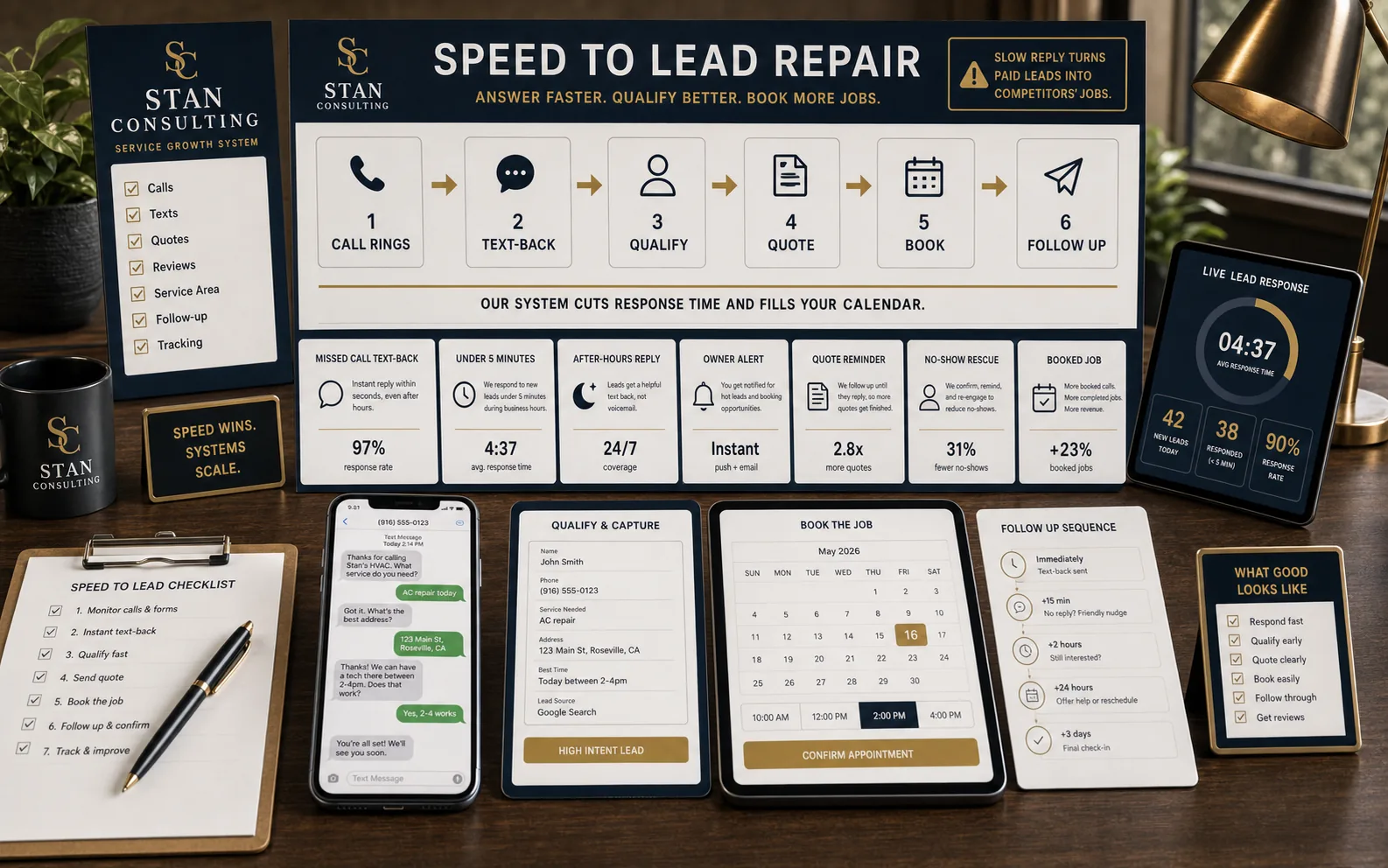
This service designs the first-response sequence around the moment the buyer acts: call, form, quote request, booking request, voicemail, missed call, or chat.
Buyer choice
What gets built or cleaned up.
Speed-to-lead work turns the first inquiry into a controlled response sequence instead of hoping someone notices the lead in time.
Immediate confirmation, next-step message, scheduling path, and status visibility.
A compact view of calls, forms, response time, contacted status, booked status, and unresolved inquiries.
Setup checklist
The page, tracking, and follow-up must answer these checks.
01 · First signal
Phone click, inbound call, voicemail, form, booking request, chat, or quote request.
02 · First response
Who replies, how fast, what message is sent, and what next action is offered.
03 · Second attempt
What happens if the buyer does not answer or does not book on the first response.
04 · Booking handoff
Calendar, dispatcher, estimator, technician, sales rep, or owner assignment.
05 · Visibility
Daily unresolved list and weekly summary so leads do not disappear inside tools.
Do not buy this if
Wrong-fit work wastes the same money the service protects.
This is not a prettier-homepage request. The work has to change what a buyer can decide and what the owner can measure.
If calls, forms, and quote requests have no owner inside the business, the first repair is responsibility, not software.
If the offer, service area, pricing signal, availability, or handoff is not real, traffic will expose that gap fast.
Questions before contact
What owners usually ask before this work starts.
Is this automation?
Partly, but not blind automation. The point is to make the first human action obvious, fast, and logged.
Can AI help here?
Yes, for triage, drafting, summaries, and alerts, but the owner still needs clear rules, ownership, and review.
What should be avoided?
Do not add more lead sources before missed calls, slow replies, and unresolved quote requests are visible.
Fit check
Good fit when the team can change the page, offer, tracking, or follow-up.
Bring the page, campaign, offer, tracking, and follow-up context. The growth plan shows which step is losing calls, quotes, orders, bookings, or sales.
The company has real demand, budget, or traffic, and can change the page, offer, proof, tracking, follow-up, or spend logic.
The useful move: more activity will not fix weak targeting, a weak page, missing tracking, or slow follow-up.
The web address, the offer, the ad or search source, the sales action that should happen, and what currently happens instead.
Start your build, profile, campaign, or intake path that should be producing.
Stan Consulting sends the request to the right service, a one-layer repair, or a system build. The goal is fewer choices and a clearer next commercial move.
Request a quoteBuyer check
What to check before choosing this service
The service should move each inquiry to the right owner, response, qualification step, and sales outcome without losing context.
Good fit
Use it when leads arrive but replies are late, routing is unclear, estimates or proposals stall, or the business cannot see the final disposition.
Check first
Check source capture, assignment, response time, message sequence, qualification, reminders, sales notes, and the booked or closed outcome.