



Use the intake path
Share the URL, campaign, store, page, or decision that should be producing calls, quote requests, purchases, booked work, or cleaner owner decisions.
Home / Services / Website Conversion Diagnostic
Website conversion diagnostic
Updated June 2026 · written diagnostic
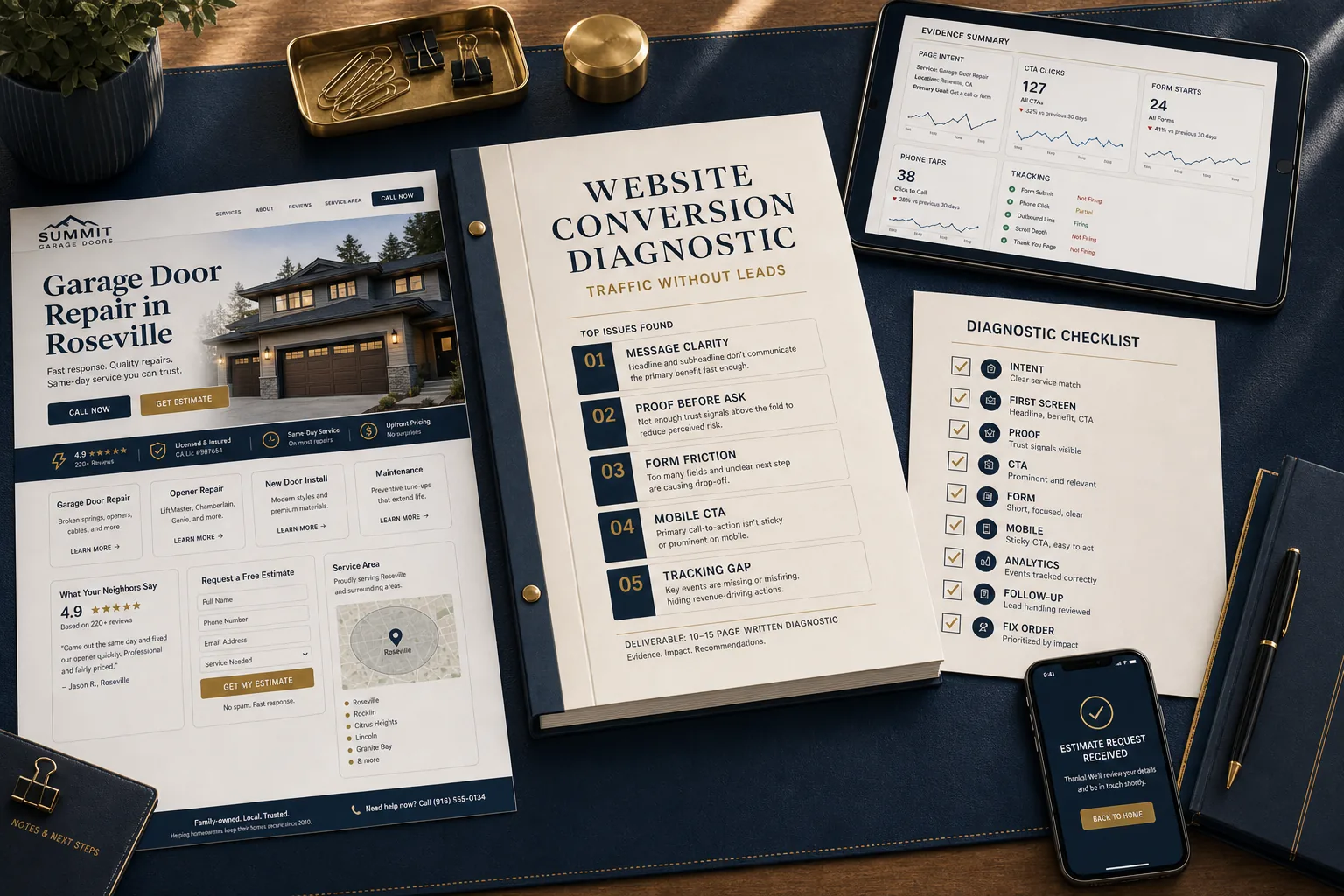
Use this when traffic exists but calls, forms, quote requests, purchases, or booked work do not follow. SC reads intent match, first-screen clarity, proof, CTA path, form friction, mobile path, tracking, and follow-up before recommending a redesign.
buyer decision
Use this when the page gets attention but does not create a qualified next action. Stan Consulting ties buyer language, proof, page hierarchy, and conversion action into one visible path.
Offer clarity
Website Conversion Diagnostic is for companies whose website should be producing more calls, quote requests, bookings, or sales. The work is a written review of the message, CTA path, form friction, trust sequence, mobile experience, traffic match, analytics, and buyer objections before any redesign.
The page does not ask you to study a framework first. It gives you the commercial decision, what is included, and the next action.
The method behind every engagement
Stan Consulting reads a business situation across five layers. Every engagement starts here. The number anchors. The method extends.
The page the buyer lands on, hierarchy and trust.
Paid surface, funnel mechanics, structure, spend.
Tracking, attribution, the actual revenue trail.
What is being sold, the price, the proof.
What happens after the click, the form, the call.
Visual diagnostic
Stan Consulting reviews the page like a buyer would: message, proof, offer, friction, tracking, and follow-up. The output is a clearer path from attention to action.
Simple process
Share the URL, campaign, store, page, or decision that should be producing calls, quote requests, purchases, booked work, or cleaner owner decisions.
Stan Consulting reviews the situation and points the request to the right paid scope: review, repair, consulting, build, or advisory.
You get the next action, owner decision, and implementation sequence without a vague exploratory call.
Why buyers trust the page
A weak conversion rate can come from page hierarchy, offer mismatch, tracking, traffic quality, form friction, or follow-up. The diagnostic names the cause before budget moves.
The review checks whether the buyer can understand the offer, trust the proof, and take the next action on desktop and mobile.
The output tells the owner whether to repair the current page, rebuild a step, fix tracking, change traffic, or tighten follow-up first.
Shows a website and lead-system repair where the page, proof, and follow-up path mattered together. Read the proof or start with the Conversion Second Opinion.
The decision in front of you
The same revenue work, three different commitments. Read the row that matters to you. The Stan Consulting column is gold-marked.
Questions before contact
It is for companies whose website should be producing more calls, quote requests, bookings, or sales. If there is no live offer, page, campaign, store, or decision yet, start with the contact form so the request can be scoped correctly.
You get message clarity, cta path, form friction, priority fixes, plus the next action that should happen first.
Scoped is the visible starting point or pricing band for this service. Variable work is priced after the asset, account, timeline, and owner involvement are clear.
Review after intake. Response comes through the intake path after the context is submitted.
Not as the first move. Submit the situation first so the conversation starts with the real page, campaign, store, or decision instead of a blank sales call.
That is common. The work can review the current setup, direct the internal team, or define what the outside vendor should fix first.
This service answers these pains
Diagnostic table
Short answer: A website conversion problem is not always a design problem. SC checks whether intent, proof, offer, CTA, form, tracking, and follow-up can turn attention into action.
| Buyer signal | What it can mean | What SC checks | Money risk |
|---|---|---|---|
| Visitors arrive but calls, forms, quotes, or purchases stay weak | The page may not match buyer intent, may not prove enough, or may bury the next action. | First screen, offer clarity, proof density, CTA path, form friction, mobile path, tracking, and follow-up. | Traffic spend continues while the lead path stays untrusted or unclear. |
| Forms submit but sales do not move | The conversion event may be counted while lead quality, follow-up, or intake is broken. | Event firing, form routing, lead qualification, response path, CRM evidence, and call-to-booked-work movement. | The dashboard says conversion while the business still loses revenue. |
| Do not change first | Do not redesign the whole site before the failing page layer is named. | The diagnostic separates page, traffic, offer, tracking, and follow-up causes. | A redesign can hide the original cause and spend budget without improving the buying decision. |
Start with the buyer problem this service should solve. Read the matching problem.
Website lead-system proof shows how page, proof, and follow-up path mattered together. See results or read the proof.
Different businesses lose action in different places. Choose your industry closest to the buying moment.
If the failure crosses more than one layer, move the decision through the written diagnostic before implementation. Start with the Conversion Second Opinion.
Use the intake path when the site has traffic but the revenue action is weak. SC reads the page, proof, CTA, form, mobile path, tracking, and follow-up before scope is quoted.
Start website conversion review